SCTF The Last Honest Witness Writeup
SCTF The Last Honest Witness WriteupSCTF The Last Honest Witness WriteupSCTF The Last Honest Witness 문제 풀이SCTF The Last Honest Witness writeup
Contents
1. 분석 대상
이 문제는 SCTF의 misc 문제이다. 제공된 자료에는 Setup과 LastHonestWitness 계열 컨트랙트, Groth16 verifier, 회로 파일, 증명 생성에 필요한 자료가 들어 있다. 문제 설명에는 손상된 문서와 OCR 로그처럼 보이는 문장이 섞여 있지만 믿을 수 있는 것은 컨트랙트가 검사하는 값과 체인에 올라간 상태이다.
최종 목표는 claim(...) 호출 통과다. 이 함수는 크게 네 가지를 본다.
1. LastHonestWitness 회로에 대한 Groth16 proof
2. Page A plaintext
3. Page B ECDSA signature
4. Page C low 40-bit Keccak collisionSetup에는 Challenge 주소와 RSA 관련 값이 남아 있다.
slot 0 = challenge address
slot 1 = modulus N
slot 2 = public exponent e
slot 3 = ciphertext c
LastHonestWitness 쪽에서는 merkleRoot가 storage slot 3에 있고 claim(...)은 proof의 public signal이 아래 값들과 일치하는지 먼저 검사한다.
publicSignals[0] = modulus
publicSignals[1] = merkleRoot
publicSignals[2] = RECIPIENT_COMMITMENT
publicSignals[3] = nullifierHash
publicSignals[4] = EXTERNAL_NULLIFIER
풀이는 체인에서 RSA 값과 Merkle root를 읽는 데서 시작한다. 숨겨진 witness plaintext를 복구한 뒤 회로가 요구하는 Merkle path와 proof를 만든다. 이후 세 장의 loose page는 독립적인 보조 조건으로 처리하면 된다.
2. 풀이
RSA 부분부터 풀었다. 회로는 p와 q를 각각 60비트 이하로 제한하고 p * q = modulus만 강제한다. 실제 인스턴스에서 읽은 N은 두 소수가 매우 가까운 형태였고 Fermat factorization으로 바로 분해됐다.
실행한 인스턴스에서는 다음 값을 확인했다.
N = 615429951214616213145619887722161253
e = 65537
c = 374681811952606249888216577959474076

p = 784493436055779473
q = 784493436055795861
plaintext = 474401937379412746004845p와 q를 얻으면 phi = (p - 1) * (q - 1)에서 개인 지수 d를 계산하고 c^d mod N으로 plaintext를 복구한다.
회로에서 witness는 Poseidon 기반 commitment와 Merkle path로 검증된다. 확인해야 하는 관계는 다음과 같다.
p * q = modulus
commitment = Poseidon(1, plaintext)
identity = Poseidon(2, plaintext, p, q, externalNullifier)
leaf = Poseidon(3, identity, commitment)
node = Poseidon(4, left, right)
nullifier = Poseidon(5, identity, externalNullifier)
트리는 32개 leaf로 구성된다. 실제 witness leaf는 아래 인덱스에 들어가고 나머지는 빈 leaf 규칙으로 채워진다.
activeIndex = (plaintext + p + q) mod 32
emptyLeaf = Poseidon(6, index, externalNullifier)
복구한 값으로 계산한 Merkle root가 체인에서 읽은 root와 일치하면, 같은 입력으로 Groth16 proof를 만들 수 있다. 위 인스턴스에서는 activeIndex = 19였고 계산된 nullifierHash도 proof의 public signal로 사용했다.
Loose page 세 개는 각각 다른 약점을 갖고 있다.
Page A는 Franklin-Reiter related-message 형태이다.
c1 = m^3 mod n
c2 = (m + 1337)^3 mod n
x^3 - c1과 (x + 1337)^3 - c2의 polynomial gcd를 Z/nZ에서 구하면 선형 인자가 나오고 여기서 plaintext를 얻을 수 있다.
pageAPlaintext = 25774616630246150697727911729Page B는 secp256k1 public key의 scalar가 2^20보다 작다고 알려준다. scalar multiplication을 작은 범위에서 brute force하면 개인키는 789123이다. 컨트랙트는 PAGE_B_MESSAGE_HASH에 대해 ecrecover 결과가 고정된 signer 주소인지 검사하므로, 이 hash를 그대로 서명해야 한다.
private scalar = 789123
v = 28
r = 0xc3349965986bd706337e04fd1a6a740e1f759a5d95ec4d2854655fc414ec6402
s = 0x432d7ce0d69b4a37abd4504c03aac315e27d666b6720d0624a2d2984cfcd346a
Page C는 keccak256(abi.encodePacked(PAGE_C_TAG, value))의 하위 40비트만 비교한다. 입력은 서로 다른 uint32 두 개면 되므로 birthday search로 충분히 충돌을 찾을 수 있다.
pageCLeft = 1656330
pageCRight = 2582757
low40 = 0x6bdab550bd
3. Exploit
solver는 체인 상태를 읽고 RSA plaintext를 복구하고 Merkle input과 Groth16 proof를 만든 뒤 claim(...)을 호출한다. RSA 복구 부분은 다음과 같다.
const [p, q] = fermatFactor(N);
const phi = (p - 1n) * (q - 1n);
const d = inv(e, phi);
const plaintext = modPow(c, d, N);
Fermat factorization은 ceil(sqrt(N))에서 시작해 a^2 - N이 제곱수가 되는 지점을 찾는다. 이번 인스턴스에서는 두 소수가 충분히 가까워서 반복 없이 바로 분해됐다.
function fermatFactor(n) {
  let a = isqrt(n);
  if (a * a < n) a++;

  while (true) {
    const b2 = a * a - n;
    const b = isqrt(b2);
    if (b * b === b2) return [a - b, a + b];
    a++;
  }
}
그다음 Poseidon/Merkle 계산으로 회로 입력을 만들고 Groth16 proof를 생성한다. proof의 public signal에는 modulus, merkleRoot, RECIPIENT_COMMITMENT, nullifierHash, EXTERNAL_NULLIFIER가 들어가야 한다.
마지막 호출에 들어가는 고정 page 값은 다음과 같다.
pageAPlaintext = 25774616630246150697727911729
pageBv = 28
pageBr = 0xc3349965986bd706337e04fd1a6a740e1f759a5d95ec4d2854655fc414ec6402
pageBs = 0x432d7ce0d69b4a37abd4504c03aac315e27d666b6720d0624a2d2984cfcd346a
pageCLeft = 1656330
pageCRight = 2582757claim(...)의 인자는 proof와 public signal을 제외하면 위 값들로 채워진다.
claim(
  proofA,
  proofB,
  proofC,
  publicSignals,
  pageAPlaintext,
  pageBv,
  pageBr,
  pageBs,
  pageCLeft,
  pageCRight
)
실행 결과 트랜잭션은 성공했고 isSolved()도 true로 바뀌었다.
transactionHash = 0xe089268d902d0a2c82296bcb2f69995e0bdfe70509781cbe395e6b43580fce54
status = 1
isSolved = true
4. Flag
SCTF{SYC_!ntern_Ray}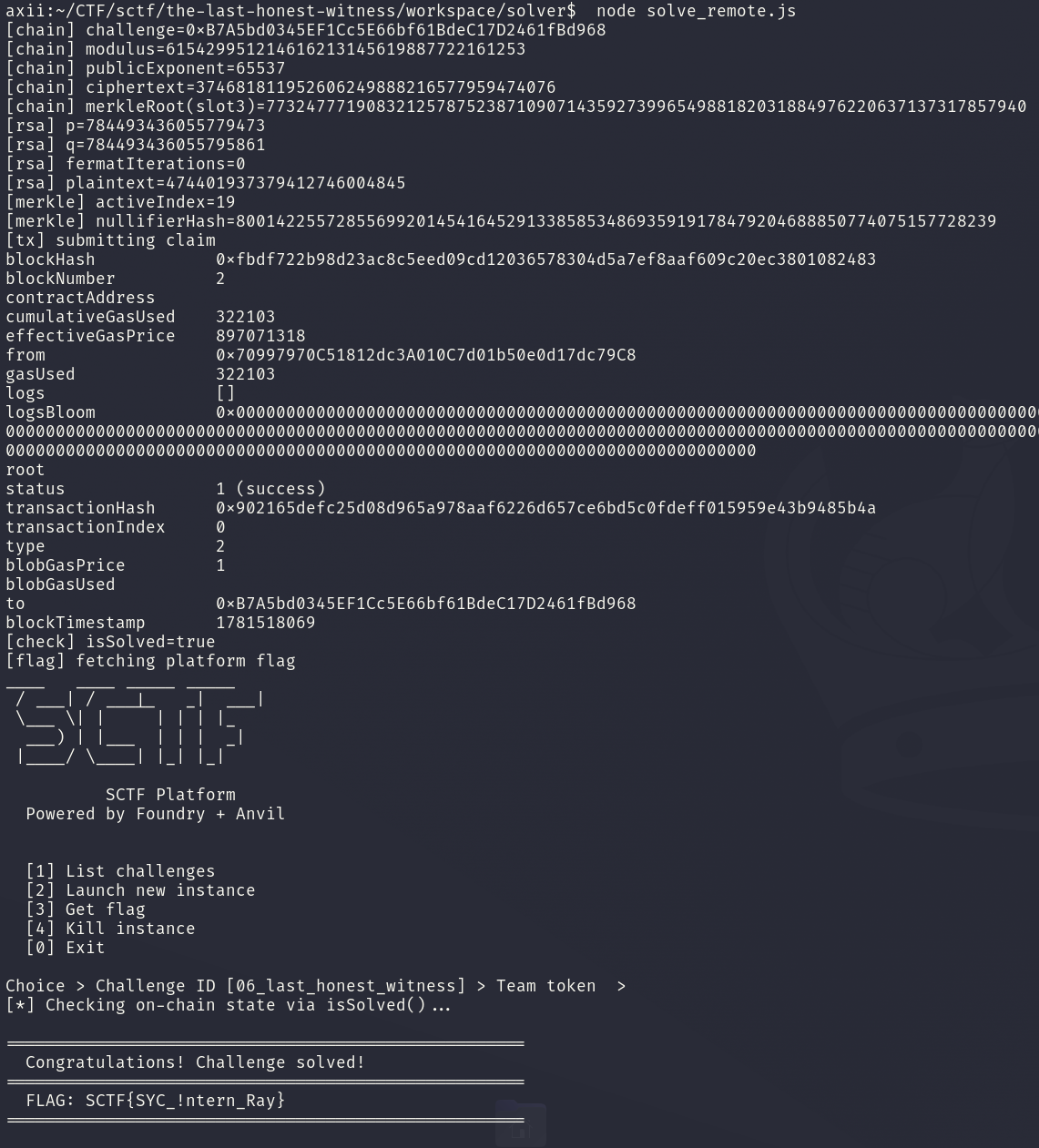
1. Analysis focus
The provided files contain the Setup and LastHonestWitness contract family, a Groth16 verifier, the circuit files, and the materials needed to generate a proof.
The goal is to get claim(...) to pass. It checks four inputs.
1. Groth16 proof for the LastHonestWitness circuit
2. Page A plaintext
3. Page B ECDSA signature
4. Page C low 40-bit Keccak collision
Setup contains the Challenge address and the RSA-related values.
slot 0 = challenge address
slot 1 = modulus N
slot 2 = public exponent e
slot 3 = ciphertext c
In LastHonestWitness, merkleRoot is stored in storage slot 3, and claim(...) first checks that the proof's public signals match the following values.
publicSignals[0] = modulus
publicSignals[1] = merkleRoot
publicSignals[2] = RECIPIENT_COMMITMENT
publicSignals[3] = nullifierHash
publicSignals[4] = EXTERNAL_NULLIFIER
The solve starts by reading the RSA values and Merkle root from the chain. After recovering the hidden witness plaintext, I build the Merkle path and proof required by the circuit. The three loose pages are independent side conditions handled separately.
2. Solution approach
I first looked at the RSA part. The circuit restricts p and q to at most 60 bits each, and only enforces p * q = modulus. In the live instance, N read from the chain consisted of two primes that were very close to each other, so it factored immediately with Fermat factorization.
In the instance I ran, I confirmed the following values.
N = 615429951214616213145619887722161253
e = 65537
c = 374681811952606249888216577959474076

p = 784493436055779473
q = 784493436055795861
plaintext = 474401937379412746004845
Once p and q are known, we can compute the private exponent d from phi = (p - 1) * (q - 1) and recover the plaintext as c^d mod N.
In the circuit, the witness is verified through a Poseidon-based commitment and a Merkle path. The relationships that need to hold are as follows.
p * q = modulus
commitment = Poseidon(1, plaintext)
identity = Poseidon(2, plaintext, p, q, externalNullifier)
leaf = Poseidon(3, identity, commitment)
node = Poseidon(4, left, right)
nullifier = Poseidon(5, identity, externalNullifier)
The tree consists of 32 leaves. The real witness leaf goes into the index below, and the rest are filled using the empty-leaf rule.
activeIndex = (plaintext + p + q) mod 32
emptyLeaf = Poseidon(6, index, externalNullifier)
If the Merkle root computed from the recovered values matches the root read from the chain, a Groth16 proof can be generated with the same inputs. In this instance, activeIndex = 19, and the computed nullifierHash was also used as a public signal for the proof.
The three loose pages each have different weaknesses.
Page A is a Franklin-Reiter related-message case.
c1 = m^3 mod n
c2 = (m + 1337)^3 mod n
If we compute the polynomial gcd of x^3 - c1 and (x + 1337)^3 - c2 over Z/nZ, a linear factor appears, and the plaintext can be recovered from it.
pageAPlaintext = 25774616630246150697727911729Page B tells us that the scalar of the secp256k1 public key is smaller than 2^20. Brute forcing scalar multiplication in that small range shows that the private key is 789123. The contract checks whether ecrecover on PAGE_B_MESSAGE_HASH returns the fixed signer address, so this exact hash has to be signed.
private scalar = 789123
v = 28
r = 0xc3349965986bd706337e04fd1a6a740e1f759a5d95ec4d2854655fc414ec6402
s = 0x432d7ce0d69b4a37abd4504c03aac315e27d666b6720d0624a2d2984cfcd346a
Page C only compares the low 40 bits of keccak256(abi.encodePacked(PAGE_C_TAG, value)). Since the inputs only need to be two distinct uint32 values, a birthday search is enough to find a collision.
pageCLeft = 1656330
pageCRight = 2582757
low40 = 0x6bdab550bd
3. Exploit
solve_remote.js
#!/usr/bin/env node
const fs = require("fs");
const path = require("path");
const { execFileSync } = require("child_process");
const circomlibjs = require("circomlibjs");
const { solvePageA, solvePageC } = require("./solve_fixed");

const EXTERNAL_NULLIFIER = 48879n;
const LEAF_COUNT = 32;
const RECIPIENT_COMMITMENT =
  9377985761090098792458769157668700179213141594497154267610801610404565099971n;

const PAGE_B_V = "28";
const PAGE_B_R = "0xc3349965986bd706337e04fd1a6a740e1f759a5d95ec4d2854655fc414ec6402";
const PAGE_B_S = "0x432d7ce0d69b4a37abd4504c03aac315e27d666b6720d0624a2d2984cfcd346a";

function usage() {
  console.error("usage: RPC=<url> SETUP=<addr> PRIVATE_KEY=<key> node solve_remote.js");
  process.exit(2);
}

function sh(cmd, args, opts = {}) {
  const out = execFileSync(cmd, args, {
    cwd: opts.cwd || __dirname,
    encoding: "utf8",
    stdio: opts.stdio || ["ignore", "pipe", "pipe"],
    env: process.env,
  });
  return out == null ? "" : out.trim();
}

function parseHexWord(s, name) {
  const m = s.match(/0x[0-9a-fA-F]+/);
  if (!m) throw new Error(`missing hex word for${name}:${s}`);
  return BigInt(m[0]);
}

function parseAddress(s, name) {
  const words = [...s.matchAll(/0x[0-9a-fA-F]{40,64}/g)].map((m) => m[0]);
  if (words.length === 0) throw new Error(`missing address for${name}:${s}`);
  const word = words[words.length - 1];
  return "0x" + word.slice(-40);
}

function mod(a, n) {
  const r = a % n;
  return r >= 0n ? r : r + n;
}

function egcd(a, b) {
  let x0 = 1n, x1 = 0n;
  while (b !== 0n) {
    const q = a / b;
    [a, b] = [b, a - q * b];
    [x0, x1] = [x1, x0 - q * x1];
  }
  return [a, x0];
}

function inv(a, n) {
  const [g, x] = egcd(mod(a, n), n);
  if (g !== 1n) throw new Error(`inverse does not exist, gcd=${g}`);
  return mod(x, n);
}

function modPow(base, exp, n) {
  base = mod(base, n);
  let result = 1n;
  while (exp > 0n) {
    if (exp & 1n) result = (result * base) % n;
    base = (base * base) % n;
    exp >>= 1n;
  }
  return result;
}

function isqrt(n) {
  if (n < 0n) throw new Error("negative sqrt");
  if (n < 2n) return n;
  let x0 = 1n << BigInt((n.toString(2).length + 1) >> 1);
  while (true) {
    const x1 = (x0 + n / x0) >> 1n;
    if (x1 >= x0) return x0;
    x0 = x1;
  }
}

function fermatFactor(n, maxIterations = 10000000) {
  let a = isqrt(n);
  if (a * a < n) a++;
  for (let i = 0; i <= maxIterations; i++) {
    const b2 = a * a - n;
    const b = isqrt(b2);
    if (b * b === b2) {
      const p = a - b;
      const q = a + b;
      if (p > 1n && p * q === n) return p < q ? [p, q, i] : [q, p, i];
    }
    a++;
  }
  throw new Error(`Fermat factorization exceeded${maxIterations} iterations`);
}

async function buildPrimitives() {
  const poseidon = await circomlibjs.buildPoseidon();
  const field = poseidon.F;
  const hash = (values) => BigInt(field.toString(poseidon(values)));
  return {
    commitment: (plaintext) => hash([1n, plaintext]),
    identitySecret: (plaintext, p, q) => hash([2n, plaintext, p, q, EXTERNAL_NULLIFIER]),
    leaf: (identity, commitment) => hash([3n, identity, commitment]),
    node: (left, right) => hash([4n, left, right]),
    nullifierHash: (identity) => hash([5n, identity, EXTERNAL_NULLIFIER]),
    emptyLeaf: (index) => hash([6n, BigInt(index), EXTERNAL_NULLIFIER]),
  };
}

async function merkleData(p, q, plaintext) {
  const h = await buildPrimitives();
  const activeIndex = Number((plaintext + p + q) % BigInt(LEAF_COUNT));
  const commitment = h.commitment(plaintext);
  const identitySecret = h.identitySecret(plaintext, p, q);
  const nullifierHash = h.nullifierHash(identitySecret);
  const leaves = Array.from({ length: LEAF_COUNT }, (_, i) => h.emptyLeaf(i));
  leaves[activeIndex] = h.leaf(identitySecret, commitment);

  const pathElements = [];
  const pathIndices = [];
  let pos = activeIndex;
  let level = leaves;
  while (level.length > 1) {
    pathElements.push(level[pos ^ 1]);
    pathIndices.push(pos & 1);
    const next = [];
    for (let i = 0; i < level.length; i += 2) next.push(h.node(level[i], level[i + 1]));
    level = next;
    pos = Math.floor(pos / 2);
  }

  return {
    activeIndex,
    commitment,
    identitySecret,
    nullifierHash,
    merkleRoot: level[0],
    input: {
      p: p.toString(),
      q: q.toString(),
      plaintext: plaintext.toString(),
      pathElements: pathElements.map((x) => x.toString()),
      pathIndices: pathIndices.map((x) => x.toString()),
      modulus: (p * q).toString(),
      merkleRoot: level[0].toString(),
      recipientCommitment: commitment.toString(),
      nullifierHash: nullifierHash.toString(),
      externalNullifier: EXTERNAL_NULLIFIER.toString(),
    },
  };
}

function arrayArg(value) {
  if (Array.isArray(value)) return `[${value.map(arrayArg).join(",")}]`;
  return value.toString();
}

async function main() {
  const rpc = process.env.RPC;
  const setup = process.env.SETUP;
  const privateKey = process.env.PRIVATE_KEY;
  if (!rpc || !setup || !privateKey) usage();

  const challenge = parseAddress(
    sh("cast", ["call", setup, "challenge()(address)", "--rpc-url", rpc]),
    "challenge",
  );
  const modulus = parseHexWord(sh("cast", ["storage", setup, "1", "--rpc-url", rpc]), "setup.slot1");
  const publicExponent = parseHexWord(sh("cast", ["storage", setup, "2", "--rpc-url", rpc]), "setup.slot2");
  const ciphertext = parseHexWord(sh("cast", ["storage", setup, "3", "--rpc-url", rpc]), "setup.slot3");
  const chainRoot = parseHexWord(sh("cast", ["storage", challenge, "3", "--rpc-url", rpc]), "challenge.slot3");

  console.log(`[chain] challenge=${challenge}`);
  console.log(`[chain] modulus=${modulus}`);
  console.log(`[chain] publicExponent=${publicExponent}`);
  console.log(`[chain] ciphertext=${ciphertext}`);
  console.log(`[chain] merkleRoot(slot3)=${chainRoot}`);

  const [p, q, fermatIterations] = fermatFactor(modulus);
  const phi = (p - 1n) * (q - 1n);
  const d = inv(publicExponent, phi);
  const plaintext = modPow(ciphertext, d, modulus);
  if (modPow(plaintext, publicExponent, modulus) !== ciphertext) {
    throw new Error("RSA plaintext check failed");
  }
  console.log(`[rsa] p=${p}`);
  console.log(`[rsa] q=${q}`);
  console.log(`[rsa] fermatIterations=${fermatIterations}`);
  console.log(`[rsa] plaintext=${plaintext}`);

  const data = await merkleData(p, q, plaintext);
  if (data.commitment !== RECIPIENT_COMMITMENT) {
    throw new Error(`recipient commitment mismatch:${data.commitment}`);
  }
  if (data.merkleRoot !== chainRoot) {
    throw new Error(`computed root${data.merkleRoot} != chain root${chainRoot}`);
  }
  console.log(`[merkle] activeIndex=${data.activeIndex}`);
  console.log(`[merkle] nullifierHash=${data.nullifierHash}`);

  const runDir = path.join(__dirname, "run");
  fs.mkdirSync(runDir, { recursive: true });
  const inputPath = path.join(runDir, "input.json");
  const proofPath = path.join(runDir, "proof.json");
  const publicPath = path.join(runDir, "public.json");
  fs.writeFileSync(inputPath, JSON.stringify(data.input, null, 2) + "\n");

  const snarkjs = path.join(__dirname, "node_modules", ".bin", "snarkjs");
  sh(snarkjs, [
    "groth16",
    "fullprove",
    inputPath,
    path.resolve(__dirname, "../../extracted/zk/LastHonestWitness.wasm"),
    path.resolve(__dirname, "../../extracted/zk/LastHonestWitness_final.zkey"),
    proofPath,
    publicPath,
  ], { stdio: ["ignore", "inherit", "inherit"] });
  const calldata = sh(snarkjs, ["zkey", "export", "soliditycalldata", publicPath, proofPath]);
  const [proofA, proofB, proofC, publicSignals] = JSON.parse(`[${calldata}]`);

  const pageAPlaintext = solvePageA().toString();
  const [pageCLeft, pageCRight] = solvePageC();
  const signature =
    "claim(uint256[2],uint256[2][2],uint256[2],uint256[5],uint256,uint8,bytes32,bytes32,uint256,uint256)";
  const args = [
    "send",
    challenge,
    signature,
    arrayArg(proofA),
    arrayArg(proofB),
    arrayArg(proofC),
    arrayArg(publicSignals),
    pageAPlaintext,
    PAGE_B_V,
    PAGE_B_R,
    PAGE_B_S,
    pageCLeft.toString(),
    pageCRight.toString(),
    "--rpc-url",
    rpc,
    "--private-key",
    privateKey,
  ];
  console.log("[tx] submitting claim");
  console.log(sh("cast", args));

  const solved = sh("cast", ["call", challenge, "isSolved()(bool)", "--rpc-url", rpc]);
  console.log(`[check] isSolved=${solved}`);

  if (solved === "true" && process.env.TEAM_TOKEN) {
    console.log("[flag] fetching platform flag");
    console.log(sh("python3", [path.resolve(__dirname, "../platform.py"), "flag", process.env.TEAM_TOKEN]));
  } else if (solved === "true") {
    console.log("[flag] TEAM_TOKEN is not set; run `python3 ../platform.py flag\"$TEAM_TOKEN\"` to print the flag.");
  }
}

main().catch((err) => {
  console.error(err.stack || err.message);
  process.exit(1);
});The solver reads chain state, recovers the RSA plaintext, builds the Merkle input and Groth16 proof, and then calls claim(...). The RSA recovery part:
const [p, q] = fermatFactor(N);
const phi = (p - 1n) * (q - 1n);
const d = inv(e, phi);
const plaintext = modPow(c, d, N);
Fermat factorization starts from ceil(sqrt(N)) and searches for a point where a^2 - N is a square.
function fermatFactor(n) {
  let a = isqrt(n);
  if (a * a < n) a++;

  while (true) {
    const b2 = a * a - n;
    const b = isqrt(b2);
    if (b * b === b2) return [a - b, a + b];
    a++;
  }
}
Next, the solver uses the Poseidon/Merkle computation to build the circuit input and generate the Groth16 proof. The proof public signals must contain modulus, merkleRoot, RECIPIENT_COMMITMENT, nullifierHash, and EXTERNAL_NULLIFIER.
The fixed page values used in the final call are as follows.
pageAPlaintext = 25774616630246150697727911729
pageBv = 28
pageBr = 0xc3349965986bd706337e04fd1a6a740e1f759a5d95ec4d2854655fc414ec6402
pageBs = 0x432d7ce0d69b4a37abd4504c03aac315e27d666b6720d0624a2d2984cfcd346a
pageCLeft = 1656330
pageCRight = 2582757
Except for the proof and public signals, the arguments to claim(...) are filled with the values above.
claim(
  proofA,
  proofB,
  proofC,
  publicSignals,
  pageAPlaintext,
  pageBv,
  pageBr,
  pageBs,
  pageCLeft,
  pageCRight
)
The transaction succeeded, and isSolved() also changed to true.
transactionHash = 0xe089268d902d0a2c82296bcb2f69995e0bdfe70509781cbe395e6b43580fce54
status = 1
isSolved = true
4. Flag
SCTF{SYC_!ntern_Ray}