SCTF Cipher_Chain Writeup
SCTF Cipher_Chain WriteupSCTF Cipher_Chain WriteupSCTF Cipher_Chain 문제 풀이SCTF Cipher_Chain writeup
Contents
1. 분석 대상
제공 자료는 두 단계로 나뉜다. Task1에서는 GF(65537) 위의 행렬 G와 ciphertext가 주어지고 숨겨진 벡터 h를 복구해야 한다. Task2에서는 Task1에서 얻은 seed를 이용해 X25519 세션 값을 만들고 암호화된 payload를 복호화해야 한다.
Task1에서 h는 단순한 nullspace 벡터가 아니다. 조건은 다음과 같이 정리된다.
h_i in {-1, 0, 1}
sum h_i^2 = 10
sum_i h_i * G[i][k] = 0 mod 65537, for k = 0..13
즉 h는 부호가 있는 weight 10의 sparse ternary vector이다. GF(65537)에서 선형 조건만 풀면 후보 공간이 너무 넓고 실제로 써야 하는 제한은 h 자체의 작은 weight와 {-1, 0, 1} 값 범위에 있다.
Task2 쪽에서는 trace에 다음 정보가 남아 있다.
secret_stage = compress(seed)
burn_counter = 0xc350
exchange = montgomery25519
payload_mode = stream-mask
여기서 확인해야 할 부분은 burn이 X25519 교환 전인지 후인지이다. 올바른 순서를 찾으면 task2.log의 session_prefix로 중간 상태를 검증할 수 있고 이후 payload는 반복 mask로 복호화된다.
2. 풀이
Task1은 전체 3^30 공간을 직접 보는 대신 meet-in-the-middle로 나누어 풀었다. 좌표 0..14와 15..29를 분리하고 각 절반에서 가능한 signed sum을 만든다.
S = sum sign_i * G[i]
S_left + S_right = 0 mod 65537
weight도 함께 나눈다.
w_left + w_right = 10한쪽 절반의 signed sum을 테이블에 저장하고 다른 절반을 열거하면서 -S가 존재하는지 찾으면 된다. 각 원소의 부호 조합은 Gray code로 순회해서 한 단계마다 바뀐 row 하나만 더하거나 빼도록 했다. 이렇게 하면 매 후보마다 14차원 합을 처음부터 다시 계산하지 않아도 된다.
이 방식으로 나온 후보는 정확히 두 개였다. 두 후보는 서로 부호가 반대인 pair였고 Task2 로그와 맞는 seed를 만드는 쪽은 다음 벡터였다.
h = [0, 1, 0, 0, -1, 1, 0, 0, 0, 1, 0, 0, 0, -1, 0,
     0, 0, 1, 0, 0, -1, 0, -1, 0, 0, 0, 1, 0, -1, 0]
Task1 설명에 있는 KDF를 그대로 적용하면 seed가 나온다.
material = b"Curve_Link_Task1_Hard|P=65537|w=10|h=" + b",".join(str(h_i).encode() for h_i in h)
stream   = SHA256(material || uint32_be(0)) || SHA256(material || uint32_be(1)) || ...
seed     = ciphertext XOR stream[:len(ciphertext)]
복구된 seed는 아래 값이다.
seed_hex = 6147466a794858316157646164616465
seed_ascii = aGFjyHX1aWdadade
Task2에서는 이 seed를 먼저 SHA-256으로 압축하고 그 결과를 0xc350번 더 해시한 뒤 X25519 private scalar로 사용했다.
secret  = SHA256(seed)
secret  = SHA256(secret), repeated 0xc350 times
shared  = X25519(secret, task2.pub)
session = SHA256(shared)
이 순서로 계산한 session의 앞 8바이트가 로그와 일치한다.
session = 621e27e55f647db45de3639d5e040220206a823be5f98a2ea68de942863cb9d3
session_prefix = 621e27e55f647db4
이제 payload 복호화는 간단하다. SHA256(session)을 32바이트 mask로 만들고 암호문 길이만큼 반복해서 XOR하면 된다.
mask = SHA256(session)
plaintext = ciphertext XOR repeat(mask)
3. Exploit
solver는 Task1 후보를 meet-in-the-middle로 복구한 뒤, 각 후보에서 seed를 만들고 Task2의 session prefix를 만족하는 후보만 payload 복호화까지 진행한다. 아래는 전체 코드이다.
#!/usr/bin/env python3
import ast
import hashlib
import re
import struct
from itertools import combinations
from pathlib import Path

from cryptography.hazmat.primitives.asymmetric import x25519


ROOT = Path(__file__).resolve().parents[1]
P = 65537
N = 30
M = 14
WEIGHT = 10
BURN = 0xC350


def load_task1():
    text = (ROOT / "extracted/attachment/task1.txt").read_text()
    g_text = text.split("G =", 1)[1].split("ciphertext_hex", 1)[0].strip()
    if g_text.endswith(","):
        g_text = g_text[:-1]
    g = ast.literal_eval(g_text)
    ct_hex = re.search(r"ciphertext_hex\s*=\s*([0-9a-fA-F]+)", text).group(1)
    return g, bytes.fromhex(ct_hex)


def vec_key(vec):
    out = 0
    for x in vec:
        out = out * P + (x % P)
    return out


def neg_vec_key(vec):
    out = 0
    for x in vec:
        out = out * P + ((-x) % P)
    return out


def count_half(weight, n=15):
    from math import comb

    return comb(n, weight) * (1 << weight)


def enumerate_signed(rows, weight, offset):
    """Yield (sum_key, encoded_half) for exact signed Hamming weight."""
    indexes = range(len(rows))
    for comb in combinations(indexes, weight):
        acc = [0] * M
        code = 0
        for pos in comb:
            row = rows[pos]
            for j, value in enumerate(row):
                acc[j] += value
            code |= 1 << (2 * (offset + pos))

        prev_gray = 0
        yield vec_key(acc), code

        for mask in range(1, 1 << weight):
            gray = mask ^ (mask >> 1)
            changed = gray ^ prev_gray
            bit = changed.bit_length() - 1
            pos = comb[bit]
            row = rows[pos]
            shift = 2 * (offset + pos)
            if (gray >> bit) & 1:
                # +1 -> -1 changes the contribution by -2*row.
                for j, value in enumerate(row):
                    acc[j] -= 2 * value
                code = (code & ~(3 << shift)) | (2 << shift)
            else:
                # -1 -> +1 changes the contribution by +2*row.
                for j, value in enumerate(row):
                    acc[j] += 2 * value
                code = (code & ~(3 << shift)) | (1 << shift)
            prev_gray = gray
            yield vec_key(acc), code


def enumerate_signed_for_query(rows, weight, offset):
    indexes = range(len(rows))
    for comb in combinations(indexes, weight):
        acc = [0] * M
        code = 0
        for pos in comb:
            row = rows[pos]
            for j, value in enumerate(row):
                acc[j] += value
            code |= 1 << (2 * (offset + pos))

        prev_gray = 0
        yield neg_vec_key(acc), code

        for mask in range(1, 1 << weight):
            gray = mask ^ (mask >> 1)
            changed = gray ^ prev_gray
            bit = changed.bit_length() - 1
            pos = comb[bit]
            row = rows[pos]
            shift = 2 * (offset + pos)
            if (gray >> bit) & 1:
                for j, value in enumerate(row):
                    acc[j] -= 2 * value
                code = (code & ~(3 << shift)) | (2 << shift)
            else:
                for j, value in enumerate(row):
                    acc[j] += 2 * value
                code = (code & ~(3 << shift)) | (1 << shift)
            prev_gray = gray
            yield neg_vec_key(acc), code


def decode_code(code):
    h = []
    for i in range(N):
        v = (code >> (2 * i)) & 3
        if v == 0:
            h.append(0)
        elif v == 1:
            h.append(1)
        elif v == 2:
            h.append(-1)
        else:
            raise ValueError("invalid encoded ternary value")
    return h


def verify_h(h, g):
    if len(h) != N:
        return False
    if any(x not in (-1, 0, 1) for x in h):
        return False
    if sum(x * x for x in h) != WEIGHT:
        return False
    for k in range(M):
        total = sum(h[i] * g[i][k] for i in range(N)) % P
        if total != 0:
            return False
    return True


def recover_h_candidates(g):
    left = g[:15]
    right = g[15:]
    found = {}

    for w_left in range(WEIGHT + 1):
        w_right = WEIGHT - w_left
        left_count = count_half(w_left)
        right_count = count_half(w_right)
        if left_count <= right_count:
            store_rows, store_w, store_off = left, w_left, 0
            query_rows, query_w, query_off = right, w_right, 15
        else:
            store_rows, store_w, store_off = right, w_right, 15
            query_rows, query_w, query_off = left, w_left, 0

        table = {}
        for key, code in enumerate_signed(store_rows, store_w, store_off):
            # Collisions are mathematically possible only for duplicate sums; keep all.
            previous = table.get(key)
            if previous is None:
                table[key] = code
            elif isinstance(previous, list):
                previous.append(code)
            else:
                table[key] = [previous, code]

        for key, code in enumerate_signed_for_query(query_rows, query_w, query_off):
            hit = table.get(key)
            if hit is None:
                continue
            hits = hit if isinstance(hit, list) else [hit]
            for stored_code in hits:
                h = decode_code(stored_code | code)
                if verify_h(h, g):
                    found[tuple(h)] = h

    return list(found.values())


def task1_seed(h, ciphertext):
    material = (
        b"Curve_Link_Task1_Hard|P=65537|w=10|h="
        + b",".join(str(x).encode() for x in h)
    )
    stream = b""
    counter = 0
    while len(stream) < len(ciphertext):
        stream += hashlib.sha256(material + struct.pack(">I", counter)).digest()
        counter += 1
    return bytes(a ^ b for a, b in zip(ciphertext, stream))


def burn_secret(secret):
    out = secret
    for _ in range(BURN):
        out = hashlib.sha256(out).digest()
    return out


def x25519_exchange(secret32, pub32):
    priv = x25519.X25519PrivateKey.from_private_bytes(secret32)
    pub = x25519.X25519PublicKey.from_public_bytes(pub32)
    return priv.exchange(pub)


def load_task2():
    task2_dir = ROOT / "extracted/attachment/task2"
    peer_pub = (task2_dir / "task2.pub").read_bytes()
    ciphertext = (task2_dir / "task2.enc").read_bytes()
    log_text = (task2_dir / "task2.log").read_text()
    prefix_hex = re.search(r"session_prefix\s*=\s*([0-9a-fA-F]+)", log_text).group(1)
    return peer_pub, ciphertext, bytes.fromhex(prefix_hex)


def try_task2(seed):
    peer_pub, ciphertext, expected_prefix = load_task2()

    # trace: secret_stage=compress(seed), burn_counter=0xc350, exchange=montgomery25519
    secret = burn_secret(hashlib.sha256(seed).digest())
    shared = x25519_exchange(secret, peer_pub)
    session = hashlib.sha256(shared).digest()
    if session[: len(expected_prefix)] != expected_prefix:
        return None

    # payload_mode=stream-mask: the 32-byte session mask is repeated over the payload.
    mask = hashlib.sha256(session).digest()
    stream = bytes(mask[i % len(mask)] for i in range(len(ciphertext)))
    plaintext = bytes(a ^ b for a, b in zip(ciphertext, stream))
    return {
        "secret": secret,
        "shared": shared,
        "session": session,
        "mask": mask,
        "plaintext": plaintext,
    }


def main():
    g, task1_ct = load_task1()
    candidates = recover_h_candidates(g)
    print(f"task1_candidates={len(candidates)}")
    for idx, h in enumerate(candidates):
        seed = task1_seed(h, task1_ct)
        print(f"[{idx}] h={h}")
        print(f"[{idx}] seed_hex={seed.hex()}")
        try:
            print(f"[{idx}] seed_ascii={seed.decode()!r}")
        except UnicodeDecodeError:
            pass
        task2 = try_task2(seed)
        if task2 is not None:
            print(f"[{idx}] task2_secret_after_burn={task2['secret'].hex()}")
            print(f"[{idx}] task2_shared={task2['shared'].hex()}")
            print(f"[{idx}] task2_session={task2['session'].hex()}")
            print(f"[{idx}] task2_mask={task2['mask'].hex()}")
            print(f"[{idx}] flag={task2['plaintext'].decode()!r}")


if __name__ == "__main__":
main()실행하면 후보 두 개가 나오고 두 번째 후보만 Task2 로그의 session prefix를 만족한다.
task1_candidates=2
[1] seed_hex=6147466a794858316157646164616465
[1] seed_ascii='aGFjyHX1aWdadade'
[1] task2_session=621e27e55f647db45de3639d5e040220206a823be5f98a2ea68de942863cb9d3
[1] flag='SCTF{curve25519_bsuiahduie_cif_diqw}'
4. Flag
SCTF{curve25519_bsuiahduie_cif_diqw}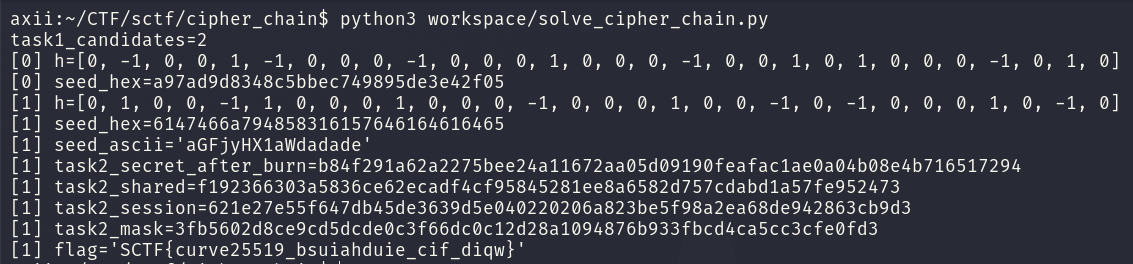
1. Analysis focus
The provided materials are split into two stages. In Task1, a matrix G over GF(65537) and a ciphertext are given, and the hidden vector h must be recovered. In Task2, the seed obtained from Task1 is used to create an X25519 session value and decrypt the encrypted payload.
In Task1, h is not a simple nullspace vector. The conditions can be summarized as follows.
h_i in {-1, 0, 1}
sum h_i^2 = 10
sum_i h_i * G[i][k] = 0 mod 65537, for k = 0..13
In other words, h is a sparse ternary vector of signed weight 10. Solving only the linear condition over GF(65537) leaves a candidate space that is too large; the actual constraints to use are the small weight of h itself and the value range {-1, 0, 1}.
For Task2, the trace contains the following information.
secret_stage = compress(seed)
burn_counter = 0xc350
exchange = montgomery25519
payload_mode = stream-mask
The part to verify here is whether the burn happens before or after the X25519 exchange. Once the correct order is found, the session_prefix in task2.log can be used to validate the intermediate state, and the payload can then be decrypted with a repeating mask.
2. Solution approach
I solved Task1 with meet-in-the-middle instead of directly searching the full 3^30 space. I split the coordinates into 0..14 and 15..29, and generated all possible signed sums for each half.
S = sum sign_i * G[i]
S_left + S_right = 0 mod 65537
The weight is split as well.
w_left + w_right = 10Store the signed sums from one half in a table, then enumerate the other half and check whether -S exists. I iterated through each element's sign combinations in Gray-code order so that only one changed row had to be added or subtracted at each step. This avoids recomputing the 14-dimensional sum from scratch for every candidate.
This method produced exactly two candidates. The two candidates were a pair with opposite signs, and the one that produced the seed matching the Task2 log was the following vector.
h = [0, 1, 0, 0, -1, 1, 0, 0, 0, 1, 0, 0, 0, -1, 0,
     0, 0, 1, 0, 0, -1, 0, -1, 0, 0, 0, 1, 0, -1, 0]
Applying the KDF described in Task1 directly gives the seed.
material = b"Curve_Link_Task1_Hard|P=65537|w=10|h=" + b",".join(str(h_i).encode() for h_i in h)
stream   = SHA256(material || uint32_be(0)) || SHA256(material || uint32_be(1)) || ...
seed     = ciphertext XOR stream[:len(ciphertext)]
The recovered seed is below.
seed_hex = 6147466a794858316157646164616465
seed_ascii = aGFjyHX1aWdadade
In Task2, this seed is first compressed with SHA-256, then hashed 0xc350 additional times, and the result is used as the X25519 private scalar.
secret  = SHA256(seed)
secret  = SHA256(secret), repeated 0xc350 times
shared  = X25519(secret, task2.pub)
session = SHA256(shared)
The first 8 bytes of the session computed in this order match the log.
session = 621e27e55f647db45de3639d5e040220206a823be5f98a2ea68de942863cb9d3
session_prefix = 621e27e55f647db4
Payload decryption then only needs the mask. Compute SHA256(session) as a 32-byte mask and repeat it for the ciphertext length, then XOR.
mask = SHA256(session)
plaintext = ciphertext XOR repeat(mask)
3. Exploit
The solver recovers Task1 candidates with meet-in-the-middle, derives a seed from each candidate, and proceeds to payload decryption only for the candidate that satisfies Task2's session prefix. The full code is below.
#!/usr/bin/env python3
import ast
import hashlib
import re
import struct
from itertools import combinations
from pathlib import Path

from cryptography.hazmat.primitives.asymmetric import x25519

ROOT = Path(__file__).resolve().parents[1]
P = 65537
N = 30
M = 14
WEIGHT = 10
BURN = 0xC350

def load_task1():
    text = (ROOT / "extracted/attachment/task1.txt").read_text()
    g_text = text.split("G =", 1)[1].split("ciphertext_hex", 1)[0].strip()
    if g_text.endswith(","):
        g_text = g_text[:-1]
    g = ast.literal_eval(g_text)
    ct_hex = re.search(r"ciphertext_hex\s*=\s*([0-9a-fA-F]+)", text).group(1)
    return g, bytes.fromhex(ct_hex)

def vec_key(vec):
    out = 0
    for x in vec:
        out = out * P + (x % P)
    return out

def neg_vec_key(vec):
    out = 0
    for x in vec:
        out = out * P + ((-x) % P)
    return out

def count_half(weight, n=15):
    from math import comb

    return comb(n, weight) * (1 << weight)

def enumerate_signed(rows, weight, offset):
    """Yield (sum_key, encoded_half) for exact signed Hamming weight."""
    indexes = range(len(rows))
    for comb in combinations(indexes, weight):
        acc = [0] * M
        code = 0
        for pos in comb:
            row = rows[pos]
            for j, value in enumerate(row):
                acc[j] += value
            code |= 1 << (2 * (offset + pos))

        prev_gray = 0
        yield vec_key(acc), code

        for mask in range(1, 1 << weight):
            gray = mask ^ (mask >> 1)
            changed = gray ^ prev_gray
            bit = changed.bit_length() - 1
            pos = comb[bit]
            row = rows[pos]
            shift = 2 * (offset + pos)
            if (gray >> bit) & 1:
                # +1 -> -1 changes the contribution by -2*row.
                for j, value in enumerate(row):
                    acc[j] -= 2 * value
                code = (code & ~(3 << shift)) | (2 << shift)
            else:
                # -1 -> +1 changes the contribution by +2*row.
                for j, value in enumerate(row):
                    acc[j] += 2 * value
                code = (code & ~(3 << shift)) | (1 << shift)
            prev_gray = gray
            yield vec_key(acc), code

def enumerate_signed_for_query(rows, weight, offset):
    indexes = range(len(rows))
    for comb in combinations(indexes, weight):
        acc = [0] * M
        code = 0
        for pos in comb:
            row = rows[pos]
            for j, value in enumerate(row):
                acc[j] += value
            code |= 1 << (2 * (offset + pos))

        prev_gray = 0
        yield neg_vec_key(acc), code

        for mask in range(1, 1 << weight):
            gray = mask ^ (mask >> 1)
            changed = gray ^ prev_gray
            bit = changed.bit_length() - 1
            pos = comb[bit]
            row = rows[pos]
            shift = 2 * (offset + pos)
            if (gray >> bit) & 1:
                for j, value in enumerate(row):
                    acc[j] -= 2 * value
                code = (code & ~(3 << shift)) | (2 << shift)
            else:
                for j, value in enumerate(row):
                    acc[j] += 2 * value
                code = (code & ~(3 << shift)) | (1 << shift)
            prev_gray = gray
            yield neg_vec_key(acc), code

def decode_code(code):
    h = []
    for i in range(N):
        v = (code >> (2 * i)) & 3
        if v == 0:
            h.append(0)
        elif v == 1:
            h.append(1)
        elif v == 2:
            h.append(-1)
        else:
            raise ValueError("invalid encoded ternary value")
    return h

def verify_h(h, g):
    if len(h) != N:
        return False
    if any(x not in (-1, 0, 1) for x in h):
        return False
    if sum(x * x for x in h) != WEIGHT:
        return False
    for k in range(M):
        total = sum(h[i] * g[i][k] for i in range(N)) % P
        if total != 0:
            return False
    return True

def recover_h_candidates(g):
    left = g[:15]
    right = g[15:]
    found = {}

    for w_left in range(WEIGHT + 1):
        w_right = WEIGHT - w_left
        left_count = count_half(w_left)
        right_count = count_half(w_right)
        if left_count <= right_count:
            store_rows, store_w, store_off = left, w_left, 0
            query_rows, query_w, query_off = right, w_right, 15
        else:
            store_rows, store_w, store_off = right, w_right, 15
            query_rows, query_w, query_off = left, w_left, 0

        table = {}
        for key, code in enumerate_signed(store_rows, store_w, store_off):
            # Collisions are mathematically possible only for duplicate sums; keep all.
            previous = table.get(key)
            if previous is None:
                table[key] = code
            elif isinstance(previous, list):
                previous.append(code)
            else:
                table[key] = [previous, code]

        for key, code in enumerate_signed_for_query(query_rows, query_w, query_off):
            hit = table.get(key)
            if hit is None:
                continue
            hits = hit if isinstance(hit, list) else [hit]
            for stored_code in hits:
                h = decode_code(stored_code | code)
                if verify_h(h, g):
                    found[tuple(h)] = h

    return list(found.values())

def task1_seed(h, ciphertext):
    material = (
        b"Curve_Link_Task1_Hard|P=65537|w=10|h="
        + b",".join(str(x).encode() for x in h)
    )
    stream = b""
    counter = 0
    while len(stream) < len(ciphertext):
        stream += hashlib.sha256(material + struct.pack(">I", counter)).digest()
        counter += 1
    return bytes(a ^ b for a, b in zip(ciphertext, stream))

def burn_secret(secret):
    out = secret
    for _ in range(BURN):
        out = hashlib.sha256(out).digest()
    return out

def x25519_exchange(secret32, pub32):
    priv = x25519.X25519PrivateKey.from_private_bytes(secret32)
    pub = x25519.X25519PublicKey.from_public_bytes(pub32)
    return priv.exchange(pub)

def load_task2():
    task2_dir = ROOT / "extracted/attachment/task2"
    peer_pub = (task2_dir / "task2.pub").read_bytes()
    ciphertext = (task2_dir / "task2.enc").read_bytes()
    log_text = (task2_dir / "task2.log").read_text()
    prefix_hex = re.search(r"session_prefix\s*=\s*([0-9a-fA-F]+)", log_text).group(1)
    return peer_pub, ciphertext, bytes.fromhex(prefix_hex)

def try_task2(seed):
    peer_pub, ciphertext, expected_prefix = load_task2()

    # trace: secret_stage=compress(seed), burn_counter=0xc350, exchange=montgomery25519
    secret = burn_secret(hashlib.sha256(seed).digest())
    shared = x25519_exchange(secret, peer_pub)
    session = hashlib.sha256(shared).digest()
    if session[: len(expected_prefix)] != expected_prefix:
        return None

    # payload_mode=stream-mask: the 32-byte session mask is repeated over the payload.
    mask = hashlib.sha256(session).digest()
    stream = bytes(mask[i % len(mask)] for i in range(len(ciphertext)))
    plaintext = bytes(a ^ b for a, b in zip(ciphertext, stream))
    return {
        "secret": secret,
        "shared": shared,
        "session": session,
        "mask": mask,
        "plaintext": plaintext,
    }

def main():
    g, task1_ct = load_task1()
    candidates = recover_h_candidates(g)
    print(f"task1_candidates={len(candidates)}")
    for idx, h in enumerate(candidates):
        seed = task1_seed(h, task1_ct)
        print(f"[{idx}] h={h}")
        print(f"[{idx}] seed_hex={seed.hex()}")
        try:
            print(f"[{idx}] seed_ascii={seed.decode()!r}")
        except UnicodeDecodeError:
            pass
        task2 = try_task2(seed)
        if task2 is not None:
            print(f"[{idx}] task2_secret_after_burn={task2['secret'].hex()}")
            print(f"[{idx}] task2_shared={task2['shared'].hex()}")
            print(f"[{idx}] task2_session={task2['session'].hex()}")
            print(f"[{idx}] task2_mask={task2['mask'].hex()}")
            print(f"[{idx}] flag={task2['plaintext'].decode()!r}")

if __name__ == "__main__":
main()When run, it finds two candidates, and only the second candidate satisfies the session prefix in the Task2 log.
task1_candidates=2
[1] seed_hex=6147466a794858316157646164616465
[1] seed_ascii='aGFjyHX1aWdadade'
[1] task2_session=621e27e55f647db45de3639d5e040220206a823be5f98a2ea68de942863cb9d3
[1] flag='SCTF{curve25519_bsuiahduie_cif_diqw}'
4. Flag
SCTF{curve25519_bsuiahduie_cif_diqw}