Ethernaut 07 Force
Ethernaut 07 ForceEthernaut 07 ForceEthernaut 07 Force 문제 풀이Ethernaut 07 Force writeup
Contents
문제
지문
Some contracts will simply not take your money ¯\_(ツ)_/¯
The goal of this level is to make the balance of the contract greater than zero.
Things that might help:
- Fallback methods
- Sometimes the best way to attack a contract is with another contract.
- See the "?" page above, section "Beyond the console"
코드
// SPDX-License-Identifier: MIT
pragma solidity ^0.8.0;

contract Force { /*
                   MEOW ?
         /\_/\   /
    ____/ o o \
    /~____  =ø= /
    (______)__m_m)
                   */ }
배경지식
컨트랙트가 이더를 받으려면 보통 receive()나 payable fallback()이 필요하다.
msg.data 없이 이더만 보내면 receive()가 실행되고, receive()가 없으면 fallback()으로 넘어간다. 이때 실행 가능한 payable 함수가 없으면 일반적인 이더 전송은 revert된다.
즉 Force처럼 receive()도 없고 fallback()도 없는 컨트랙트에는 transfer, send, low-level call{value: ...}("") 같은 방식으로 이더를 넣기 어렵다.
하지만 EVM에서 컨트랙트 잔액은 컨트랙트 코드가 직접 허락한 경로로만 증가하는 값이 아니다. 대표적으로 다음 두 가지 방법으로 특정 주소에 이더가 강제로 들어갈 수 있다.
- 다른 컨트랙트가
selfdestruct(target)를 호출하면서 남은 이더를target으로 보낸다. - 채굴자/검증자가 블록 보상 수령 주소를 해당 컨트랙트 주소로 지정한다.
이 문제에서는 두 번째 방법까지 갈 필요가 없고, 첫 번째 방법을 exploit 경로로 쓰면 된다.
selfdestruct(payable recipient)는 호출한 컨트랙트의 잔액을 recipient에게 보낸다. 이 전송은 수신 컨트랙트의 receive()나 fallback()을 호출하는 일반적인 메시지 호출이 아니다. 따라서 수신 컨트랙트가 이더 수신 함수를 갖고 있지 않아도 잔액이 증가할 수 있다.
EIP-6780 이후에는 selfdestruct()의 코드 삭제 동작이 제한되었지만, 이 레벨에서는 삭제 여부가 중요하지 않다. 필요한 건 공격 컨트랙트의 잔액을 Force 주소로 강제로 보내는 효과다.
문제 코드 분석
문제 컨트랙트는 비어 있다.
contract Force { /* ... */ }Force에는 상태 변수도 없고 함수도 없다. 특히 receive()와 fallback()이 없다.
따라서 플레이어가 Force 주소로 평범하게 이더를 보내면, 실행할 payable entrypoint가 없어서 전송이 실패한다. 문제의 목표는 소유권을 바꾸거나 함수를 호출하는 것이 아니라 단순히 Force의 balance를 0보다 크게 만드는 것이다.
목표는 Force 컨트랙트의 balance를 0보다 크게 만드는 것이다. 검증 조건은 대략 다음과 같다.
address(force).balance > 0컨트랙트 내부 함수가 없어도 주소 자체는 이더 잔액을 가질 수 있다. 그러니 핵심은 Force의 코드를 실행하지 않고, Force 주소의 balance만 증가시키는 방법을 찾는 것이다.
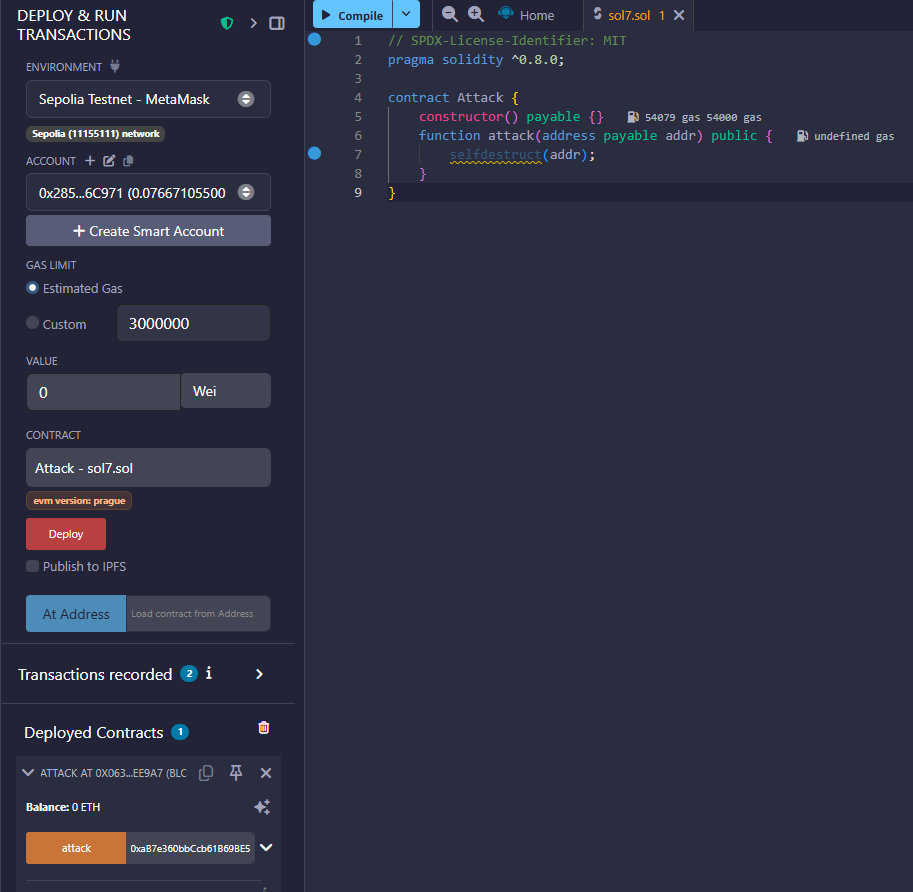
공격 컨트랙트를 payable constructor로 배포하면서 1 wei를 넣어둔다. 그 다음 공격 컨트랙트에서 selfdestruct(forceAddress)를 호출하면 공격 컨트랙트의 잔액이 Force 주소로 이동한다.
이 과정에서 Force의 receive()나 fallback()은 호출되지 않는다. 그래서 Force가 아무 함수도 갖고 있지 않아도 잔액이 생기고, 레벨 조건을 만족하게 된다.
풀이
일반 전송은 Force가 이더를 받을 함수가 없어서 실패한다. 하지만 selfdestruct()로 인한 잔액 전송은 수신자의 payable 함수 존재 여부와 무관하게 주소의 balance를 증가시킨다.
그래서 1 wei를 가진 공격 컨트랙트를 만들고, 그 컨트랙트를 selfdestruct시키면서 Force 주소를 수신자로 지정하면 된다.
익스플로잇
// SPDX-License-Identifier: MIT
pragma solidity ^0.8.0;

contract Attack {
    constructor() payable {}

    function attack(address payable target) public {
        selfdestruct(target);
    }
}
Challenge
Prompt
Some contracts will simply not take your money ¯\_(ツ)_/¯
The goal of this level is to make the balance of the contract greater than zero.
Things that might help:
- Fallback methods
- Sometimes the best way to attack a contract is with another contract.
- See the "?" page above, section "Beyond the console"
Code
// SPDX-License-Identifier: MIT
pragma solidity ^0.8.0;

contract Force { /*
                   MEOW ?
         /\_/\   /
    ____/ o o \
    /~____  =ø= /
    (______)__m_m)
                   */ }
Background
For a contract to receive ether, it usually needs a receive() or a payable fallback().
When you send only ether with no msg.data, receive() runs; if there is no receive(), it falls through to fallback(). If there is no payable function to execute at that point, an ordinary ether transfer reverts.
In other words, for a contract like Force that has neither receive() nor fallback(), it is hard to deposit ether via transfer, send, or a low-level call{value: ...}("").
But in the EVM a contract's balance is not a value that increases only through paths the contract code explicitly allows. Notably, ether can be forcibly placed at a given address in the following two ways.
- Another contract calls
selfdestruct(target)and sends its remaining ether totarget. - A miner/validator sets the block reward recipient address to that contract address.
In this challenge there is no need to go as far as the second method; the first method works as the exploit path.
selfdestruct(payable recipient) sends the calling contract's balance to recipient. This transfer is not an ordinary message call that invokes the receiving contract's receive() or fallback(). So the balance can increase even if the receiving contract has no ether-receiving function.
Since EIP-6780, selfdestruct()'s code-deletion behavior has been restricted, but whether deletion happens does not matter in this level. What we need is the effect of forcibly sending the attack contract's balance to the Force address.
Analyzing the challenge code
The challenge contract is empty.
contract Force { /* ... */ }Force has no state variables and no functions. In particular, it has no receive() and no fallback().
So if the player sends ether to the Force address in the normal way, the transfer fails because there is no payable entrypoint to execute. The goal of the challenge is not to change ownership or call a function, but simply to make Force's balance greater than 0.
The goal is to make the Force contract's balance greater than 0. The validation condition is roughly as follows.
address(force).balance > 0Even without internal functions, the address itself can hold an ether balance. So the key is to find a way to increase only the balance of the Force address without running Force's code.
We deploy the attack contract with a payable constructor, putting 1 wei into it. Then calling selfdestruct(forceAddress) from the attack contract moves the attack contract's balance to the Force address.
During this process, Force's receive() or fallback() is not called. So even though Force has no functions at all, it ends up with a balance and satisfies the level condition.
Solution
A normal transfer fails because Force has no function to receive ether. But the balance transfer caused by selfdestruct() increases the address's balance regardless of whether the recipient has a payable function.
So we create an attack contract holding 1 wei and selfdestruct that contract, specifying the Force address as the recipient.
Exploit
// SPDX-License-Identifier: MIT
pragma solidity ^0.8.0;

contract Attack {
    constructor() payable {}

    function attack(address payable target) public {
        selfdestruct(target);
    }
}